
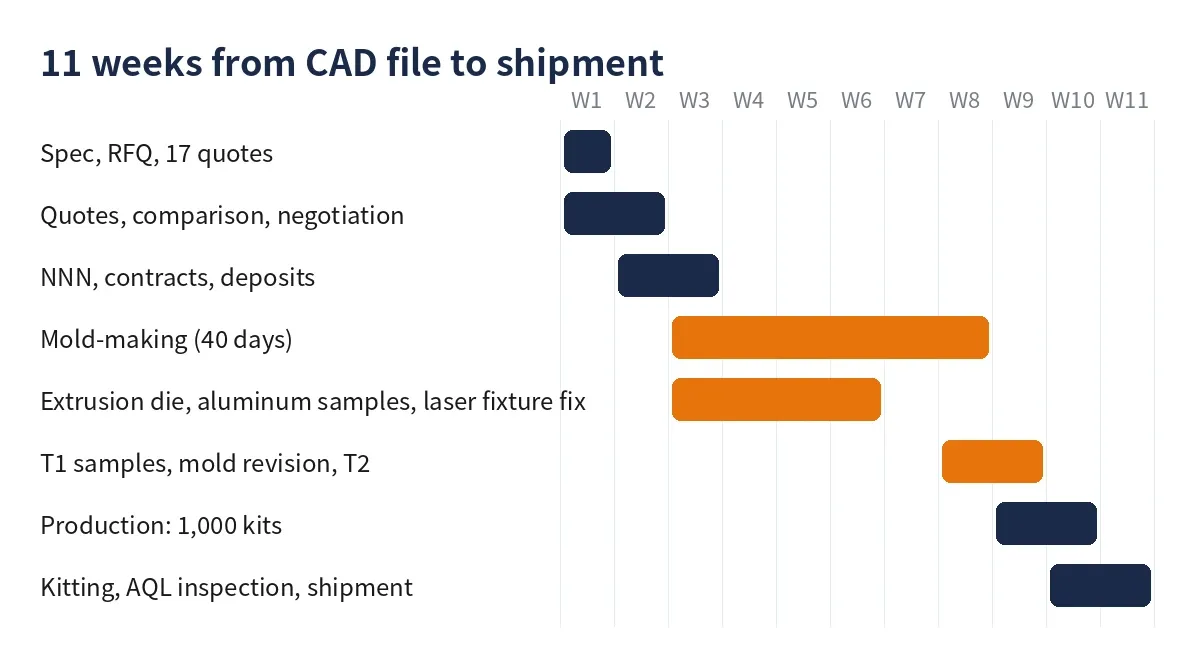
A client came to us with a CAD file and one sentence: "I need this leaving the factory in three months, and I want to start with 1,000 units." The product is a small hand tool: an anodized aluminum profile with laser-engraved markings, and two injection-molded ABS parts with brass nuts. Manufacturing a product like this in China takes two kinds of tooling, two factories 1,300 km apart, and four processes that have to agree to a fraction of a millimeter. This case study covers the 11 weeks from CAD file to shipment: 17 quotes with a sixfold price spread, factories that all wanted a bigger order, the negotiation, the contracts, delays at every supplier, and five problems we caught before the goods shipped.
Manufacturing a custom product in China: the brief
The client had done the design work: a parametric CAD model, dimensioned drawings, and a clear idea of the retail price. What they did not have was a factory, and this product does not fit inside one. It needs:
- Aluminum extrusion for a thin-walled hollow profile, cut to length.
- Anodizing and laser engraving: black anodize, then engraved markings.
- Stamping and assembly: a splice piece staked into one profile so two of them join into one long one.
- Injection molding: two ABS parts, each holding a brass nut for a clamping screw.
A plastics shop that offers "aluminum too" is buying the profile from someone else and adding a margin, and you lose the ability to talk to the people who cut the metal. So the first decision was to split the product by process.
Step 1: find the right manufacturing cluster in China
Chinese factories specialize, and the regions specialize with them. Whole towns live on one trade, with the steel dealers, heat-treatment shops, anodizing lines and freight agents that trade needs all within a short drive. Knowing which town does what is the first filter, before any single factory is considered. For this product the map looked like this:
| Process | Cluster | What it is known for |
|---|---|---|
| Injection molds and molding | Yuyao and Ningbo, Zhejiang | Small and mid-size plastic molds, a dense market of tool shops and molders, keen prices |
| Huangyan (Taizhou), Zhejiang | One of China's best-known mold towns: larger tools, housings, automotive and appliance parts | |
| Dongguan and Shenzhen, Guangdong | Precision and export-grade tooling, consumer electronics, faster sampling, higher prices | |
| Aluminum extrusion, anodizing, laser | Foshan (Nanhai district), Guangdong | The largest extrusion cluster in the country: mills, die shops, anodizing and finishing side by side |
| Dongguan, Guangdong | Metal trading and CNC finishing; many sellers cut and finish stock profile rather than extrude their own |
Our quotes came from all five. The mold shop we chose is in Yuyao and the extruder is in Foshan, 1,300 km apart, which is why final assembly needed a plan of its own.
How we find and shortlist those factories is our own trade. It rests on years in the Chinese domestic market, working in Chinese, through channels that a search on an export platform does not reach. What the client saw was the result: within a week, drawings were in front of about twenty factories, and seventeen of them came back with a price.
Step 2: send an RFQ a factory can answer in one evening
Each factory received the same package: a dimensioned PDF drawing, a STEP file, material and finish, and three quantities (1,000, 3,000 and 5,000 kits). Three quantities show how tooling, set-up fees and unit price move against each other. A quote at a single quantity hides that.
Two habits at this stage:
- No target price in the first round on custom tooling. Name a number and every quote arrives a hair under it. On a new part we want to learn what it costs before we say what we hope to pay.
- Talk, then write it down. We call the factories, get the mold engineer on video when a detail needs it, and go to the factory in person when the job calls for it. Ten minutes of conversation settles what fifty messages cannot. Then every agreed point goes into the chat thread in writing, so there is a record to point to in week nine.
Step 3: what 17 factories quoted for the same drawings
Every factory had the same files and the same three quantities. This is the range that came back:
| Item | Lowest | Highest | Spread |
|---|---|---|---|
| Injection mold tooling, two parts (10 factories) | ¥20,000 $2,990 | ¥120,800 $18,080 | 6.0× |
| Plastic parts, per kit | ¥3.90 $0.58 | ¥6.90 $1.03 | 1.8× |
| Aluminum kit, anodized and engraved, per kit (7 factories) | ¥15.50 $2.32 | ¥48.50 $7.26 | 3.1× |
| Extrusion die and punch | ¥1,500 $220 | ¥4,000 $600 | 2.7× |
| Time to first samples | 30 days | 45 days | |
| Minimum order | about 1,600 kits | 5,000 kits |
A buyer who asks three factories sees a slice of this range and has no way to know which slice. The reasons behind the spread only show up when you put the quotes side by side:
- Different grades of toolmaker. The ¥120,800 quote came from an export-grade mold shop in Shenzhen: imported mold base, four trial rounds and air-freighted samples included. It is a real price for a real service, and far more tool than a first run of 1,000 kits needs.
- Different mold layouts. Some shops quoted one family mold for all the parts, others two separate molds, one a two-cavity tool. Each choice moves money between tooling and unit price.
- Padding in operations the buyer cannot see. We asked the ¥48.50 aluminum factory for a breakdown. It listed ¥9.30 a kit for anodizing and ¥10.50 for laser engraving, several times what other factories charged for the same operations.
- Plain mistakes. One attractive aluminum price turned out to be for a single profile, not the two-profile kit. The salesman's explanation was "导轨看成1条了": I read it as one rail. Another factory sent a tidy price sheet for six parts that belonged to a different customer.
- Tax and terms. Some prices included 13% VAT, some did not. Payment terms ran from 50/50 to four milestones. One factory would treat the mold as the client's property only on paper, with conditions on ever moving it.
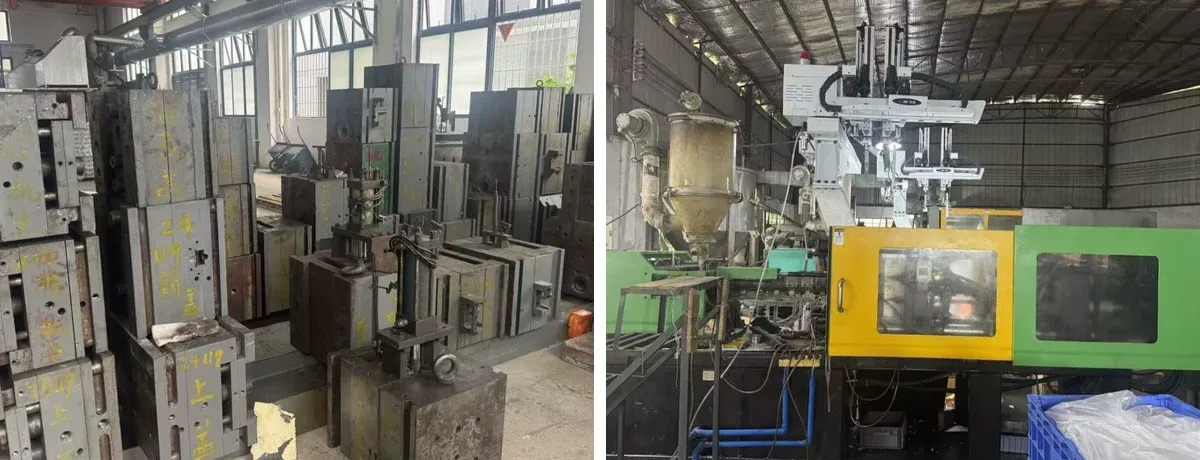
The lowest price did not win on price alone. For each finalist we weighed the mold steel and guaranteed life, who owns the tooling, payment terms, lead time, how quickly and precisely the factory answered technical questions, and whether it would sign our NNN agreement. Here are the three mold (mould) finalists on the measure that matters, the total paid:
| Factory | Tooling | Steel | Parts per kit | 1,000 kits | 3,000 kits | 5,000 kits |
|---|---|---|---|---|---|---|
| A (Yuyao, chosen) | ¥20,000 | P20 | ¥3.90 + ¥1,000 per run under 5,000 | ¥24,900 $3,730 | ¥32,700 $4,900 | ¥39,500 $5,910 |
| B (Guangdong) | ¥26,000 | 718H | ¥6.90 falling to ¥6.60 | ¥32,900 $4,930 | ¥45,800 $6,860 | ¥59,000 $8,830 |
| C (Taizhou) | ¥47,000 | 718H | ¥4.20 falling to ¥3.00 | ¥51,200 $7,660 | ¥56,900 $8,520 | ¥62,000 $9,280 |
Factory C is the instructive one. Its unit price falls to ¥3.00 at volume, the lowest of anyone, and a buyer looking only at unit price would pick it. But its tooling costs more than twice Factory A's, and the two totals do not cross until far beyond the quantities this client will buy in the first two years.
On steel: P20 is the standard pre-hardened mold steel, and Factory A guaranteed it for 500,000 shots, far more than this product will need. 718H is a grade up and polishes better. For a matte black part the customer would never see the difference. Our guide to opening a mold in China covers the grades and what each costs.
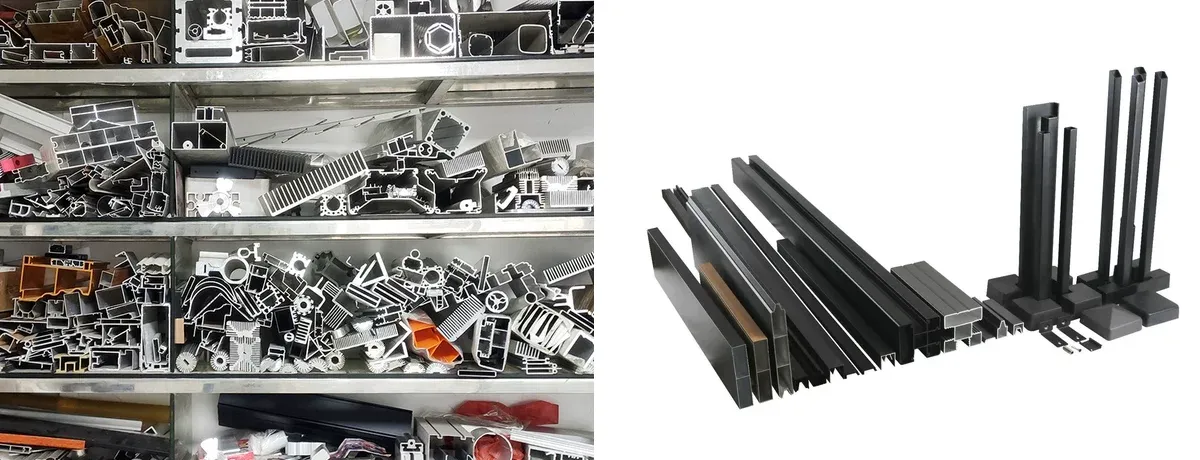
The aluminum came down to two:
| Factory | Tooling | Per kit | 1,000 kits | 3,000 kits | 5,000 kits |
|---|---|---|---|---|---|
| X (Dongguan, stock profile, no die) | none | ¥18.00 | ¥18,000 | ¥54,000 | ¥90,000 |
| Y (Foshan, chosen) | ¥4,000 | ¥15.50 | ¥19,500 | ¥50,500 | ¥81,500 |
Factory X was cheaper on the first order and needed no tooling. But it would be cutting a stock tube bought on the open market, could not say in writing which alloy it was, and answered a twelve-point specification with one word: "是的", yes. Factory Y extrudes its own profile from a die the client owns, and its tooling pays for itself at 1,600 kits. We took Y.
Every factory wanted a bigger order
The client's brief was 1,000 kits: enough to test the market without betting the company. No factory wanted that number.
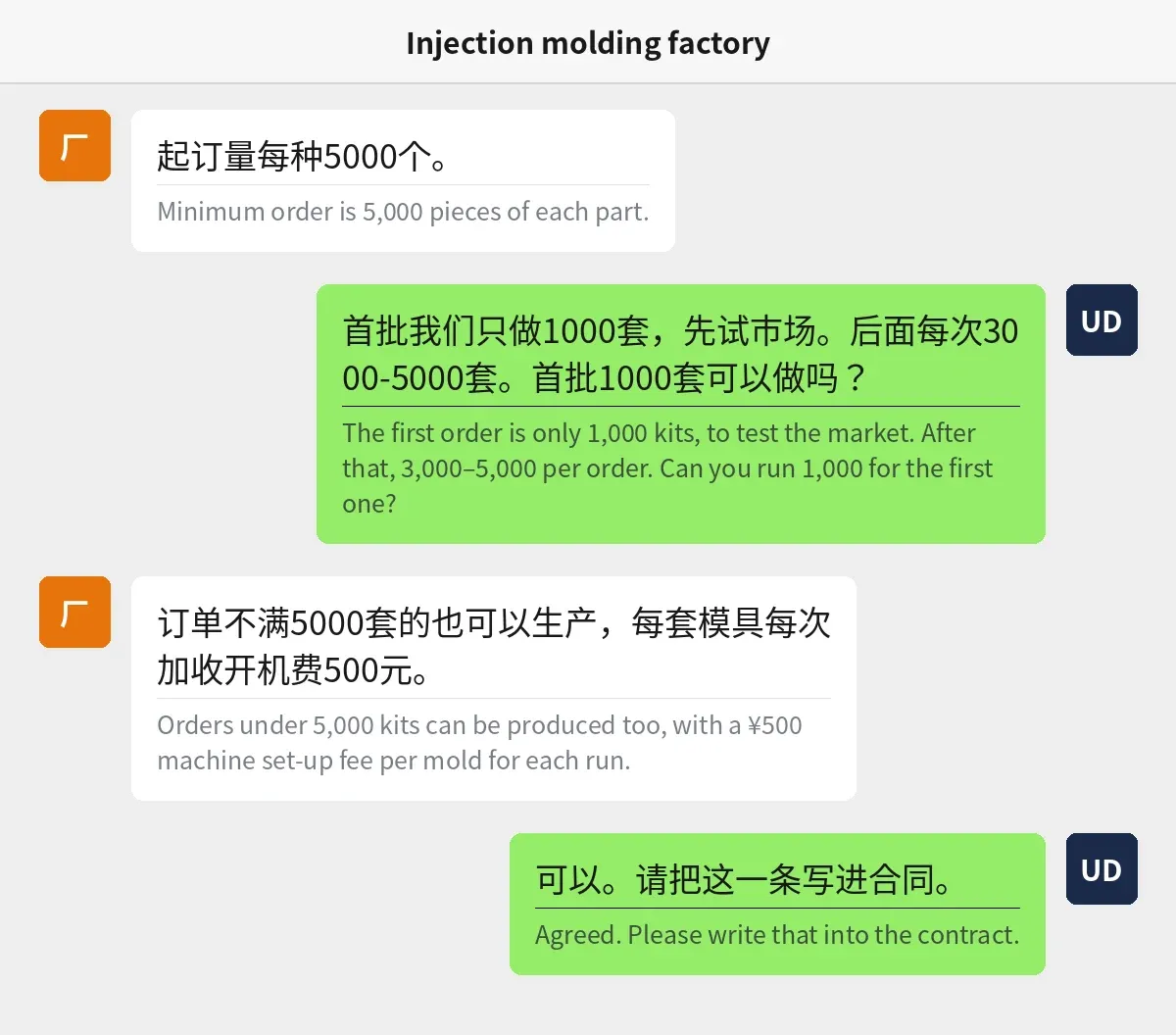
- The mold shops asked for 5,000 pieces per part, or 3,000 kits per color.
- The extruder's minimum was 300 kg of profile, about 1,600 kits' worth.
- Several quotes simply ignored the 1,000 column and priced only the larger quantities.
A minimum order is the factory's way of covering the cost of setting up a machine, and it is negotiable once you offer to cover that cost another way. We got the first order down to 1,000 kits at every supplier:
- Pay the set-up, not the volume. Factory A agreed to run 1,000 kits for a ¥500 machine set-up fee per mold. Another finalist would waive its fee only from 3,000 kits and would not move. That helped decide the choice.
- Split the material minimum. The extruder runs its full 300 kg, finishes 1,000 kits, and holds the rest of the raw profile against the reorder.
- Show the reorder plan. A factory accepts a small first order when it believes in the second one. We gave both factories the client's real plan: 1,000 kits now, 3,000 to 5,000 per order after that.
Step 4: negotiate with the factory, line by line
The aluminum price arrived in two messages. First: ¥14.50 a kit. A minute later: "加1元冲点,和组装", add one yuan for staking and assembly. So was the price 14.50 or 15.50? We asked. It was 15.50.
This is the most common way a China quote goes wrong. The factory quotes the part it thinks you asked about, and the operations you assumed were included turn up later as extras. Before comparing anything, we write back one line listing what the price includes and ask the factory to confirm it.
Then we asked for a better price, with the reorder plan as the reason.
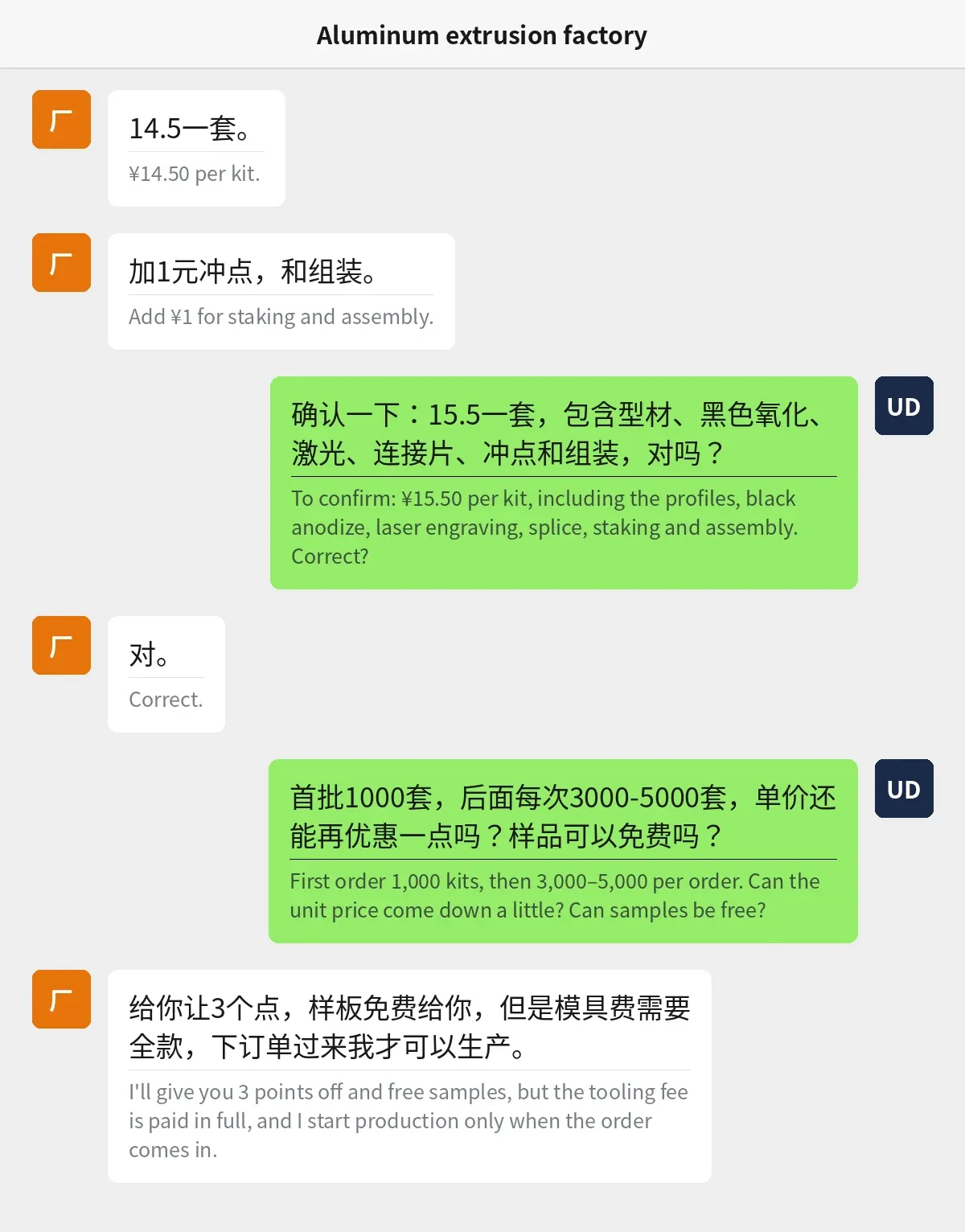
Three percent off made the first order ¥15.04 a kit. We pushed once more, not on the percentage but on the factory's own first number: you opened at 14.50, can that be the price with assembly included? They agreed to it from the second order on. A factory finds it easier to honor a figure it has already said than to invent a new discount.
What we did not push on: wall thickness, anodizing thickness, alloy. Squeeze the last 3% out of an aluminum factory and it will find that 3% in the metal. There is more on how these conversations work in WeChat for business in China.
Step 5: sign an NNN agreement and a mold ownership contract
Before the full drawings left our hands, both factories signed an NNN agreement: non-disclosure, non-use, non-circumvention. Ours is written in Chinese, governed by PRC law, names the court where the factory is registered, and carries the factory's red company seal. An English NDA under US law is very hard to enforce against a workshop in southern China. A sealed Chinese contract in the factory's home court is one the factory expects to be held to. (This is our working practice, not legal advice. For a product with real IP, have a China lawyer review the text.)
The mold factory signed our text as written. The extrusion factory signed after editing two clauses. They added a carve-out for plain tube made on their own dies for other customers, which is fair: the clause still bans selling our profile with our markings. And they asked for a lower damages figure, which we settled after one round. The clauses we would not trade were tooling ownership and the ban on selling the finished part to anyone else.
The mold contract carried more weight. The terms we got into it:
- 50% deposit, 50% after the client approves trial samples. Not after "mold completion", which the factory decides.
- 40 days from deposit to first samples, with a penalty of 0.5% of the tooling price per day from the sixth day of delay.
- The molds belong to the client and are handed over within seven days of a written request.
- Unit prices fixed for 12 months, reopened only if ABS resin rises more than 10%.
- Mold life of 500,000 shots, with free maintenance while the molds stay in the factory's shop.
One check at this stage is worth describing. The payment details in the draft contract named a personal bank account, not the factory's. That is common with small Chinese workshops, and it is also what a payment fraud looks like. Our rule: ask for the company account first. Where a workshop cannot offer one, the account holder has to be identified in the sealed contract and confirmed against the business license before any money moves. A mismatch between the company on the contract and the name on the bank account is a reason to stop and check, every time.
Step 6: design for manufacturing before the steel is cut
While the paperwork went back and forth, the mold factory reviewed the parts and flagged two things: thick sections that would sink as the plastic cooled, and a thin decorative ring that would not fill reliably. We revised the model twice. The ring went, thick walls were cored out to an even thickness, and one chamfer was reduced so the steel around it would not be knife-thin. A change in CAD costs an hour. The same change in steel costs a week.
In the same weeks the client had a preliminary patent search done for the target markets and took the results to a patent attorney. We raise this with every client who is paying for tooling on a new design: a product can be legal to make in China and still be blocked from sale in the US, and on Amazon a single complaint can take a listing down. The time to find out is before the deposit.
Every supplier ran late: why control matters
Not one supplier in this project hit its first date. The mold shop told us in advance that 30 days was impossible: "快年底了,模具也比较多", it is nearly year-end and the shop is full of molds. It committed to 40 and delivered first samples five days after that. The anodizing line was booked solid and added four days. A machining subcontractor accepted a ten-day job, then went quiet.
Delays in Chinese manufacturing rarely arrive as bad news. They arrive as silence, or as "一会", in a moment.
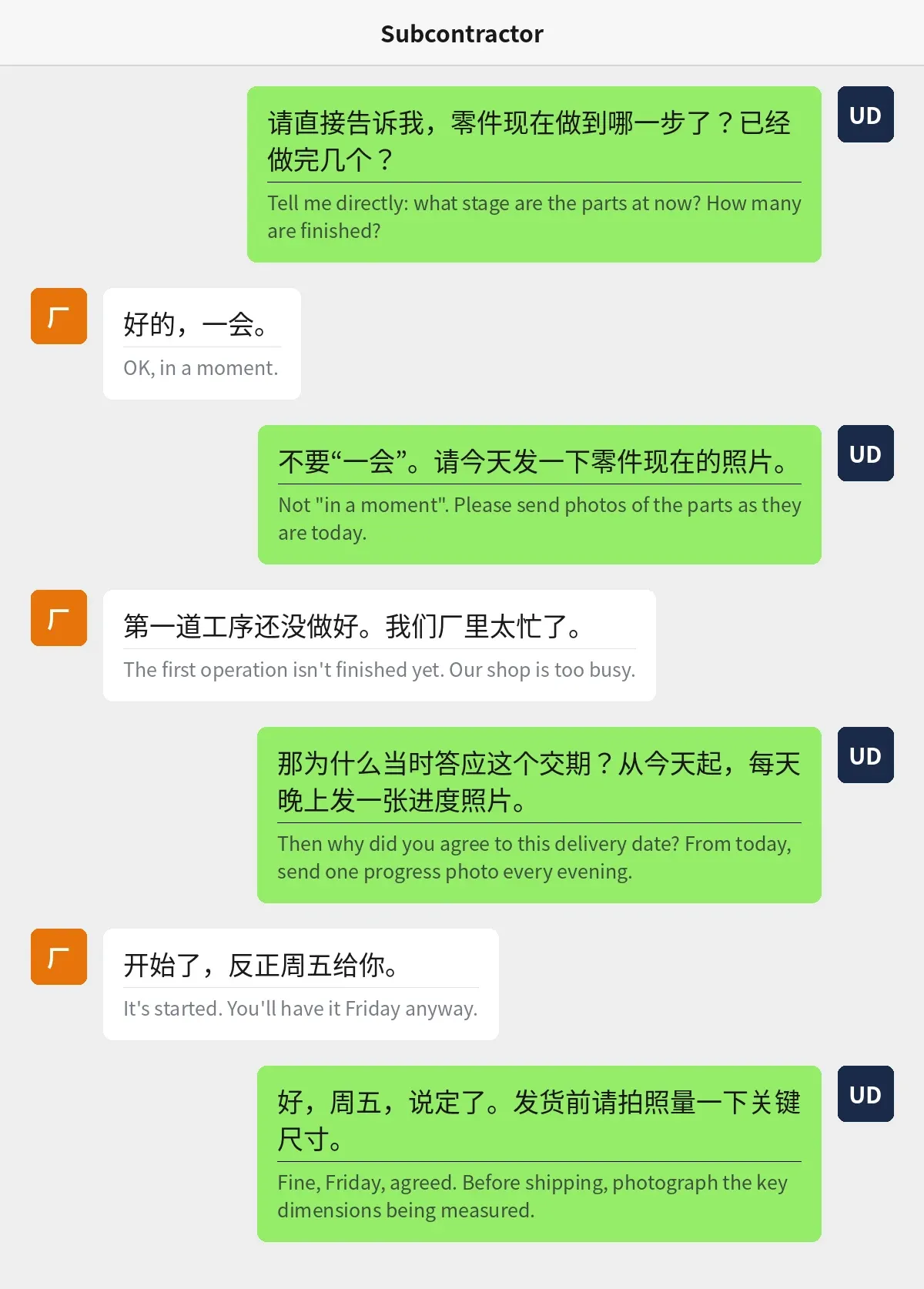
What kept the project inside 11 weeks:
- Ask for a photo, not a date. "When will it be ready?" gets an optimistic answer. "Send me a photo of the part as it is today" gets the truth.
- Check in every day once tooling starts. A two-day slip found on day two can be recovered. Found on day thirty, it is a missed shipment.
- Pick up the phone, and go there. When a thread goes quiet we call the owner. When a call is not enough, someone from our side stands on the shop floor.
- Put the date in the contract. The mold contract carried a penalty of 0.5% a day from the sixth day of delay. First samples arrived on the fifth.
- Plan for it. We told the client three months and scheduled ten weeks, so the slips had somewhere to go.
Five production problems and how QC caught them
Every tooling project has a list like this. What matters is whether the problems turn up on a sample bench or in a customer review.
| Problem | How we found it | Fix | Cost |
|---|---|---|---|
| Sink mark on the face of one plastic part, behind the pocket that holds the brass nut | First trial samples (T1), under a raking light | More coring around the pocket, lower melt temperature, longer hold time | 6 days, no charge |
| Brass nut turned in its pocket when the clamping screw was tightened hard: 2 parts in 10 | Over-torque test on T1 samples | Deeper hexagonal pocket with a tighter fit, same mold revision. Retest: 0 in 30 | 0 extra days |
| Engraved markings on the two profiles did not line up at the joint, off by 0.4 mm | First aluminum samples, joined and checked against a reference rule | New laser fixture that locates each profile from the joint end, not the outer end | 3 days |
| Two profiles in the same kit were visibly different shades of black | Pre-production sample, side by side in daylight | Profiles paired into kits from the same anodizing rack, before laser | no delay |
| Splice piece wobbled in 3 profiles out of 20 | Pull test at the factory | Punch depth increased by 0.3 mm, then a go/no-go wiggle check on every piece at the press | 1 day |
The sink mark appeared even after the design review, because the wall behind the nut pocket could only be thinned so far before the pocket lost strength. It took a mold revision and a process change together to clear it.
The engraving problem taught us the most. Each profile on its own measured perfectly. The error only existed when two were joined, and nobody at the factory had joined them, because the drawing showed one profile. We now add an assembly page to every drawing set: the parts together, with the dimension that matters after assembly called out.
Have a design at this stage? Send us the drawing and we will tell you which processes and clusters it needs.
Assembly, pre-shipment inspection and shipping to the US
The plastic parts were in Yuyao and the aluminum was in Foshan, 1,300 km apart. Somebody had to put them in one box. The extrusion factory got the job, because the profile is the long, scratch-prone part and should travel the least. The plastics went south by truck in two days, and kitting happened next to the anodizing line.
Before the balance was paid we inspected the finished lot on site: 80 kits pulled at random from 1,000 (AQL 2.5, General Level II, accept on 5 defects, reject on 6). Each one was assembled, measured at the joint and torque-tested. Two kits had light scratches and were replaced. The lot passed, the balance went out, and the cartons left the factory in week 11 for sea freight, duty paid, to the client's US warehouse. How that leg is priced is in our guide to DDP shipping from China.
What the first order cost
| Item | RMB | USD |
|---|---|---|
| Two injection molds | ¥20,000 | $2,990 |
| Extrusion die and staking punch | ¥4,000 | $600 |
| Plastic parts, 1,000 kits, with set-up fee | ¥4,900 | $730 |
| Aluminum kits, 1,000 at ¥15.04 | ¥15,040 | $2,250 |
| Total | ¥43,940 | $6,580 |
Tooling is a one-time cost. On the reorder the same kit costs about ¥18.40, or $2.75, at the factory gate.
Five things to do before you manufacture a product in China
- Get enough quotes to see the whole range. Ours ran sixfold on tooling for identical drawings. Three quotes would not have shown it.
- Compare total paid, not unit price, with set-up and minimum-run fees included, and get one written line on what each price covers.
- Treat the minimum order as a negotiation. Offer to pay the set-up cost, split the material, and show a credible reorder plan.
- Put tooling ownership and the delivery date in a sealed Chinese-language contract, and check the bank account name against it.
- Stay in contact every day once production starts. Every supplier will slip. The ones you are watching slip by days, not weeks.