
DDP stands for Delivered Duty Paid. On a DDP shipment from China to the USA, the seller or their freight forwarder moves the goods from the factory to your door and pays everything on the way: freight, export and import clearance, US duties and tariffs, and final delivery. You pay one price and receive boxes. This guide explains what a DDP price includes, what it leaves out, how DDP compares with DAP, DDU, FOB and EXW, what it costs in 2026, and the questions to ask before you accept a DDP quote.
What does DDP mean in shipping?
DDP is one of the 11 Incoterms, the trade terms published by the International Chamber of Commerce that define who pays for and who carries the risk of each leg of an international shipment. Under DDP the seller has the maximum obligation of any Incoterm: they deliver the goods to a named place in the buyer's country, cleared for import, with all duties and taxes paid. The buyer's only job is to unload.
In day-to-day China trade the word is used a little more loosely. When a factory or forwarder says "DDP to your warehouse", they mean a door-to-door service with US customs and duty handled for you. Chinese forwarders call the same thing 双清包税, "double clearance, tax included": export clearance in China and import clearance in the US are both done, and the duty is inside the price.
What is included in a DDP price
| Cost | Included in DDP? | Notes |
|---|---|---|
| Pickup from the factory or consolidation warehouse | Usually | Confirm the pickup city. Inland trucking from a remote province is sometimes extra. |
| China export clearance | Yes | Filed by the forwarder or the factory's export agent. |
| Ocean or air freight | Yes | Billed on chargeable weight: the greater of actual and volumetric. |
| US port, terminal and handling fees | Yes | Destination charges are the classic "surprise" on non-DDP terms. |
| US customs entry and broker fee | Yes | Includes the ISF filing on ocean shipments. |
| Import duty and tariffs | Yes | MFN duty plus Section 301 and any other layers that apply to your product. |
| Merchandise Processing Fee and Harbor Maintenance Fee | Yes | MPF is 0.3464% of value with a minimum of about $34 per entry. HMF is 0.125% on ocean cargo. |
| Final delivery to your address or Amazon FBA | Yes | To the door or dock. Unloading is yours. |
What DDP does not include
"All-in" has edges. These are the items that most often sit outside a DDP price, and the ones to ask about before you pay:
- Cargo insurance. DDP puts transit risk on the seller on paper, but a forwarder's liability is limited by weight, not by the value of your goods. Insure anything you cannot afford to lose.
- Customs exams. If CBP pulls the container for an X-ray or intensive exam, the exam fee and the resulting storage are usually passed through.
- Storage and redelivery. Demurrage, missed delivery appointments and refused FBA deliveries are billed at cost.
- Residential, liftgate and remote-area surcharges. A quote to a commercial dock is not a quote to a house.
- Tariff changes in transit. Duty is set by the rate on the day the goods enter the US, not the day you booked. Many DDP quotes carry a clause that passes increases on to you.
- Product compliance. FDA, FCC, CPSC and labeling requirements are the importer's responsibility whatever the Incoterm says.
- State sales tax. Not a customs matter, and never part of DDP.
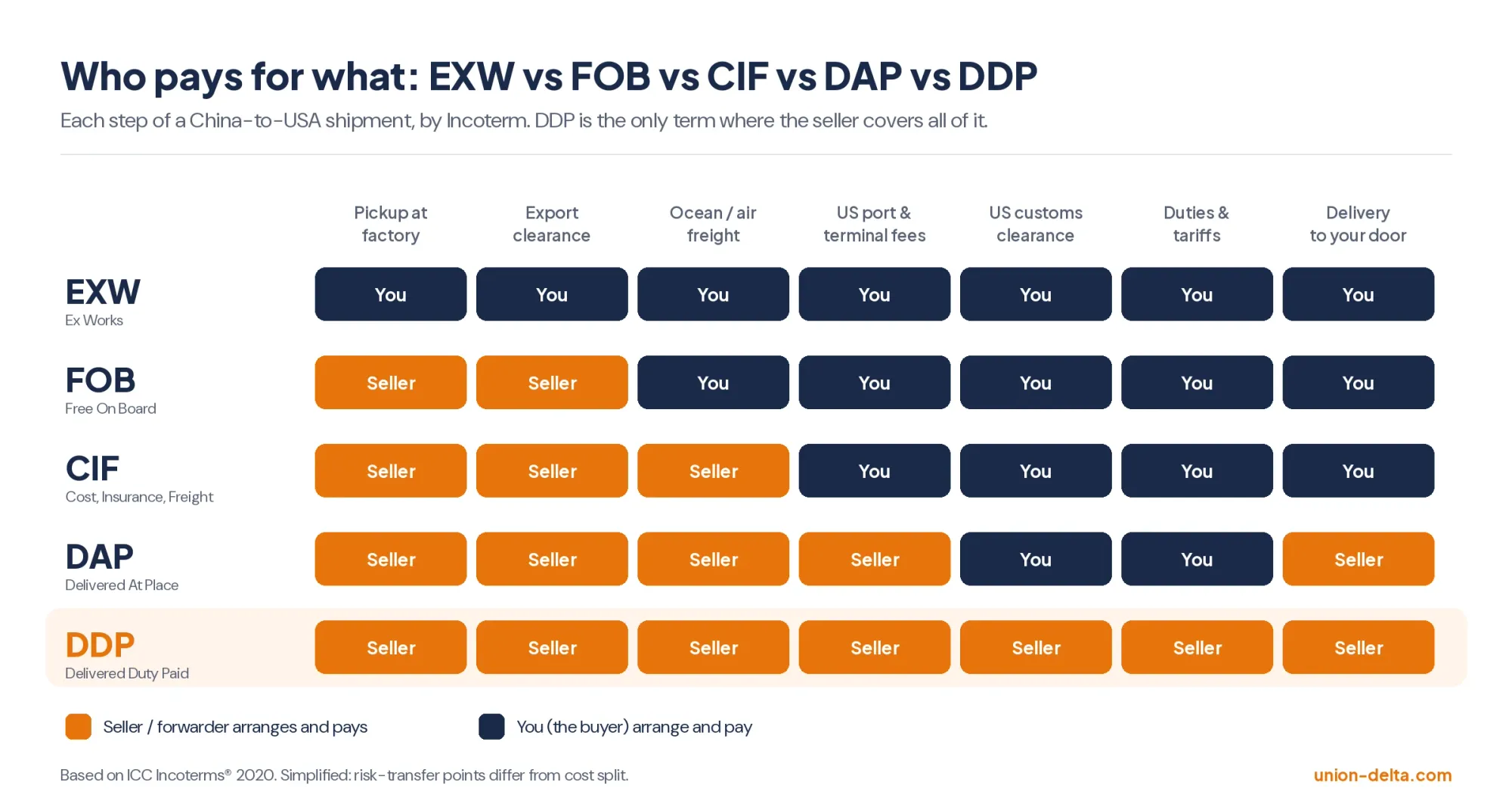
DDP vs DAP, DDU, FOB and EXW
| Term | Seller's job ends | You handle | Best for |
|---|---|---|---|
| EXW (Ex Works) | At the factory gate | Everything from pickup onward, including China export clearance | Buyers with their own forwarder in China |
| FOB (Free On Board) | Goods loaded on the vessel in China | Ocean freight, US clearance, duty, delivery | Full containers and importers with a broker |
| CIF | Freight and insurance paid to the US port | Port fees, US clearance, duty, delivery | Rarely the best choice: destination fees are not yours to negotiate |
| DAP (Delivered At Place) | Goods at your door, not cleared | US customs entry and all duties | Importers who want control of the entry |
| DDP (Delivered Duty Paid) | Goods at your door, cleared, duty paid | Unloading | Small and mid-size shipments, FBA replenishment, first imports |
DDP vs DAP
Freight and delivery are identical. The difference is one step: US customs. Under DAP you are the importer of record, your broker files the entry, and the duty bill comes to you. Under DDP the seller's side files the entry and pays. DAP gives you control and a paper trail in your own name. DDP gives you a fixed landed cost and no broker to hire.
DDP vs DDU
DDU (Delivered Duty Unpaid) was removed from the Incoterms in 2010 and replaced by DAP. Forwarders still use the word. If a quote says DDU, read it as DAP: delivered to you, duty not paid.
DDP vs FOB
FOB is a price for the goods, loaded on a ship. DDP is a price for the goods in your warehouse. To compare a FOB quote with a DDP quote, add ocean freight, destination charges, clearance, duty and trucking to the FOB number. Our guide to shipping from China to the USA walks through each of those legs.
How much does DDP shipping from China to the USA cost?
A DDP price has two parts: moving the boxes, and paying the government. The first depends on weight, volume and speed. The second depends on what the product is and what it is worth.
| Service | Typical shipment | Indicative rate | Door to door |
|---|---|---|---|
| Sea DDP, consolidated per-kg line | 21 kg to about 1,000 kg | $1.70–$2.95 /kg | 3–5 weeks |
| Fast-boat express line, duty included | 2 kg to 100 kg+ | $2.55–$4.20 /kg | 2–3 weeks |
| Air DDP | Urgent restocks, 50–500 kg | from about $6 /kg | 7–12 days |
| LCL / FCL DDP with formal entry | 2 CBM to full containers | from about $1.30 /kg | 5–6 weeks |
The duty inside the price
Since the $800 de minimis exemption ended, every commercial shipment from China pays duty. For a typical China-origin consumer product in late 2026 the bill is a stack:
- MFN base duty for the product's HTS code: 0% to about 16%.
- Section 301 China tariffs: 7.5% or 25% on most goods, higher on a few sectors.
- The 12.5% Section 301 forced-labor tariff, in force since July 24, 2026, when it replaced the 10% Section 122 tariff. Background in our explainer on the forced-labor action.
- Section 232, where the product is steel, aluminum, copper or certain furniture.
Most consumer categories land between 20% and 38% of declared value. Category-level numbers are in our tariff rates by product category. Rates change; confirm your 10-digit HTS code with a licensed customs broker before you price.
Worked example: the same shipment as DAP and as DDP
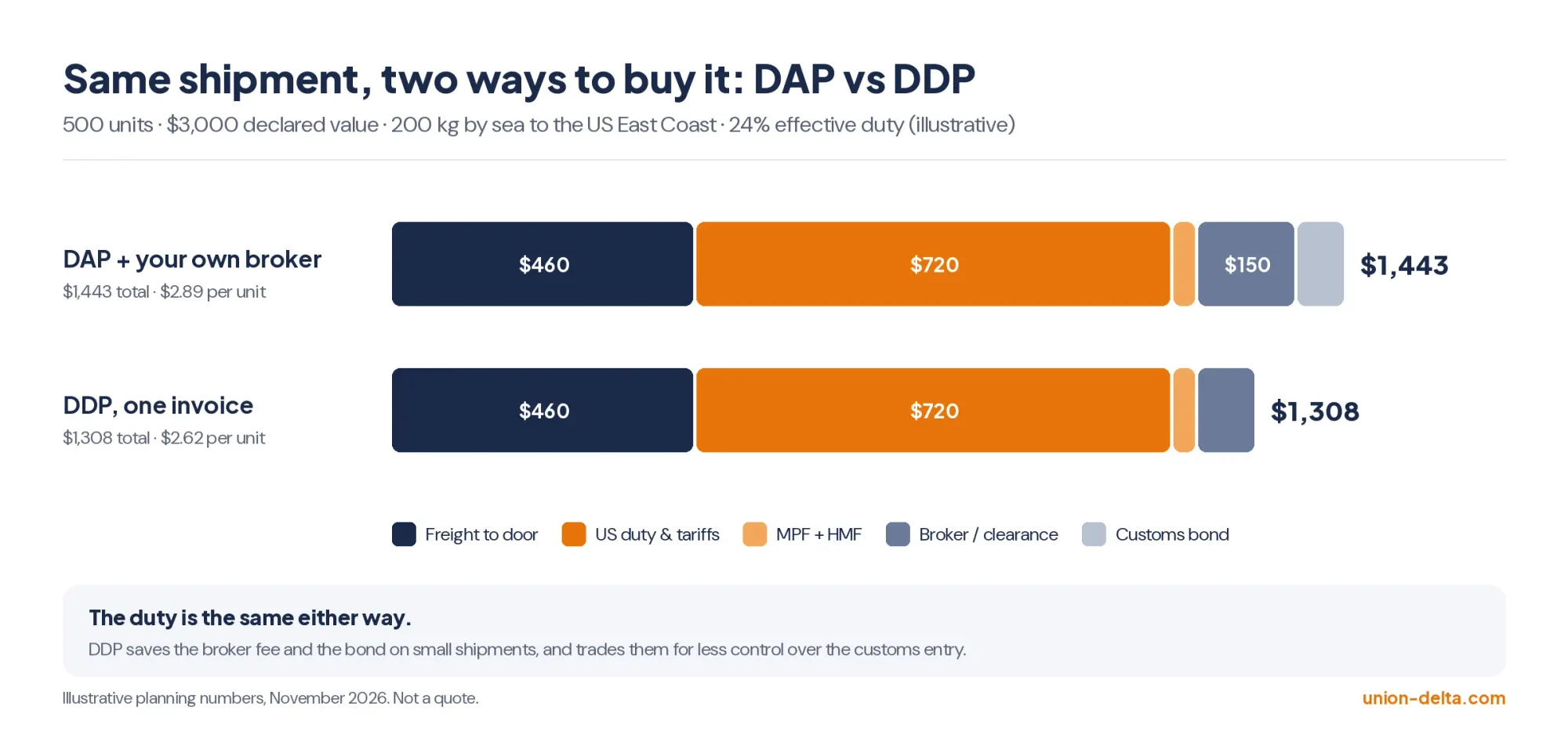
500 units of a home and kitchen product at $6.00 each. Declared value $3,000, 200 kg, by sea to the East Coast, 24% effective duty.
| Line item | DAP + your broker | DDP |
|---|---|---|
| Freight to door (200 kg × $2.30) | $460 | $460 |
| US duty and tariffs (24% of $3,000) | $720 | $720 |
| MPF + HMF | $38 | $38 |
| Customs broker / clearance handling | $150 | $90 |
| Single-entry customs bond | $75 | included |
| Total shipping and customs | $1,443 | $1,308 |
| Per unit | $2.89 | $2.62 |
The duty is the same either way. On a small shipment DDP comes out cheaper because the forwarder clears many customers' cargo under its own bond and broker and spreads the fixed fees. On a full container that advantage disappears, and a direct relationship with a broker usually wins. Either way, shipping and customs add $2.62 to $2.89 to a $6.00 unit, which is why landed cost, not factory price, is the number to build your margin on.
Why some DDP quotes are much cheaper than others
There are two kinds of DDP on the China to US lane, and they are priced differently.
- Flat per-kilogram DDP lines. The forwarder consolidates general cargo from many shippers and charges one rate per kg with the duty averaged in. The price does not move with your invoice value. This is the $1.70 to $2.95 per kg range in the table above. It works well for ordinary, low-duty general goods in cartons.
- DDP with a formal entry on your product. The forwarder quotes freight plus the duty calculated on your HTS code and declared value, as in the worked example. This is how higher-value, higher-duty and regulated goods should move.
Neither is wrong. What matters is that you know which one you are buying, and that the goods are declared as what they are, at what they cost. A quote that is far below every other quote for the same product is a reason to ask how it will be cleared.
How DDP shipping works, step by step
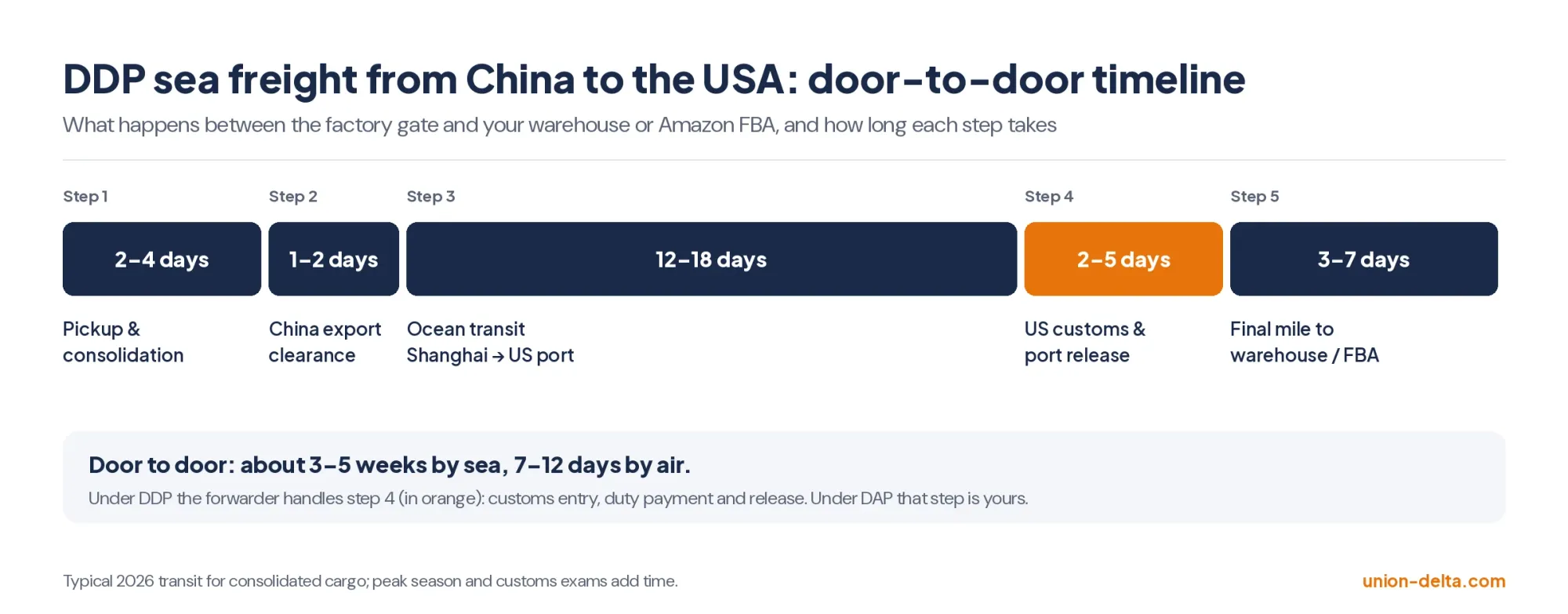
- Quote. You send the product description, HTS code if you have it, carton dimensions and weights, declared value and the delivery ZIP code.
- Pickup and consolidation. The factory delivers to the forwarder's warehouse, or the forwarder collects. Cartons are measured, weighed and labeled.
- Export clearance. The commercial invoice and packing list are filed with China Customs.
- Main transit. 12 to 18 days on the water to the West Coast, longer to the East Coast, or 2 to 5 days by air.
- US customs. The forwarder's broker files the entry, pays the duty and gets the release.
- Final mile. UPS, FedEx or a truck delivers to your warehouse or to the Amazon fulfillment center.
Who is the importer of record on a DDP shipment?
The importer of record (IOR) is the party US Customs and Border Protection holds responsible for the entry: that the goods are classified correctly, valued correctly and that the duty is paid. An Incoterm on an invoice does not change who that is. The name on the customs entry does.
On a DDP shipment the importer of record is normally one of three parties: the forwarder's US entity, a third-party IOR service the forwarder uses, or you, with the forwarder's broker filing in your name under a power of attorney. All three are legitimate, and each has consequences:
- If you are the IOR, the entry is in your records, any duty refund belongs to you, and you are responsible for what was declared. Ask for a copy of the entry summary (CBP Form 7501).
- If someone else is the IOR, you have no customs paperwork to manage, and no claim to refunds on that entry. When the courts struck down the IEEPA tariffs in 2026, refunds went to importers of record, not to the buyers who had paid through a DDP price.
- For Amazon FBA, Amazon will not act as importer of record or ultimate consignee. Someone else must, and it has to be settled before the cargo leaves China.
When DDP is the right choice, and when it is not
Seven questions to ask before you accept a DDP quote
- Who is the importer of record, and will I receive a copy of the entry summary?
- What HTS code and declared value will be used for my goods?
- Is the duty calculated on my product, or is this a flat per-kg rate?
- What happens if tariffs change while the cargo is on the water?
- Who pays for a customs exam, storage or a refused delivery?
- Which delivery is quoted: commercial dock, residential, or Amazon FBA with appointment?
- What is the liability limit if cargo is lost, and can I add insurance?
A forwarder who answers all seven in writing is one you can work with. Vague answers to the first three are the warning sign.