
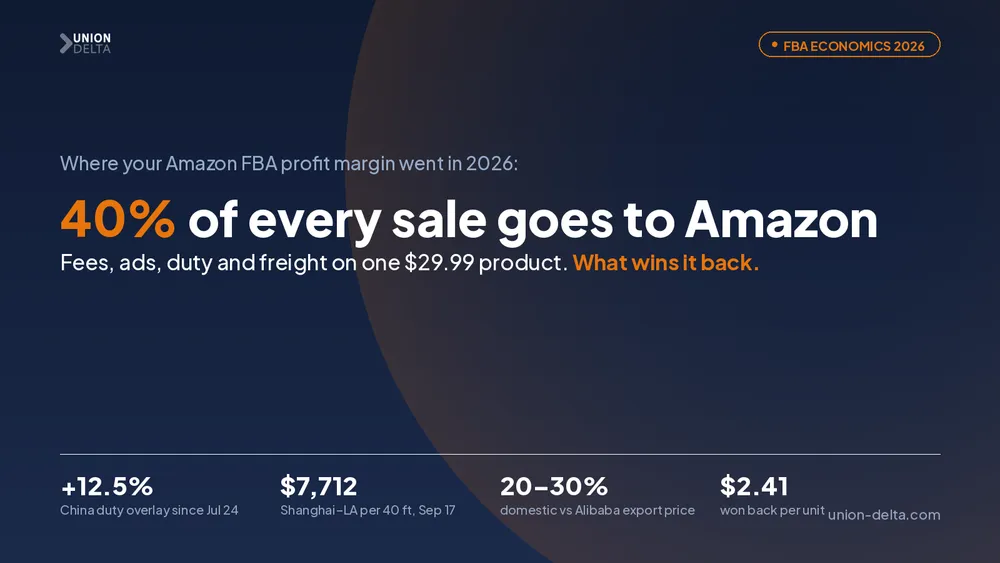
Open the new Profit Analytics dashboard in Seller Central and the number most sellers see is somewhere around 40%: that is the share of every sale that goes to Amazon once referral, fulfilment, the April surcharge, placement, storage and advertising are added up. It did not get there in one jump. It got there through a dozen small changes on Amazon's side and two large ones on the import side, the 12.5% China duty overlay since July 24 and a transpacific freight market that closed last week at $7,712 per 40-foot container. This article puts the whole cost stack on one $29.99 product, line by line, and then shows the one place where real dollars, not cents, can still be won back: the factory price and everything that is calculated on top of it.
Where every dollar of a $29.99 sale goes in 2026
Percentages hide things, so here is a real product shape: a home and kitchen item, large standard size, 12 to 16 oz packed, selling at $29.99, sourced from a Chinese factory at $6.50 FOB through an Alibaba listing, shipped by sea and advertised at a moderate 8% of sales. The Amazon rates are the 2026 US rate card including the 3.5% surcharge. The duty stack is the one that applies to most home and kitchen goods from China this month.
| Line | Basis | Per unit | Share of price |
|---|---|---|---|
| Referral fee | 15% of price | $4.50 | 15.0% |
| FBA fulfilment fee | Large standard, 12–16 oz, incl. 3.5% surcharge | $4.76 | 15.9% |
| Inbound placement fee | Minimal shipment split, standard size | $0.30 | 1.0% |
| Storage, averaged | Monthly storage spread over units sold | $0.25 | 0.8% |
| Advertising | 8% total ad cost of sales | $2.40 | 8.0% |
| Amazon, all in | $12.21 | 40.7% | |
| Factory price | $6.50 FOB, Alibaba export listing | $6.50 | 21.7% |
| Import duty | 40.9% of customs value (3.4% MFN + 25% Section 301 + 12.5% overlay) | $2.66 | 8.9% |
| Sea freight and US delivery | LCL, door to door, per unit | $1.00 | 3.3% |
| Customs entry | Broker fee spread over the order | $0.30 | 1.0% |
| FBA prep | Label, polybag, carton label | $0.50 | 1.7% |
| Landed cost, all in | $10.96 | 36.5% | |
| Returns, refunds, damage, software | Typical 7% of sales | $2.10 | 7.0% |
| Left for you | Before income tax | $4.72 | 15.7% |
That 15.7% is not a disaster. It sits right on the industry average: Jungle Scout's seller survey puts the typical Amazon net margin at 15 to 20%, with 57% of sellers above 10% and only 28% above 20%. The problem is the direction. Two years ago the same product carried no 12.5% overlay, no surcharge, a smaller fulfilment fee and cheaper ads, and the line at the bottom was closer to 25%. Marketplace Pulse's 2026 Seller Index found that 49% of Amazon sellers name marketplace fees as their main margin concern and 46% name advertising, and it classed 38% of sellers as distressed, with no growth in sight. The sellers who are still growing margin are not the ones who found a cheaper ad agency. They are the ones who changed what the product costs before it reaches Amazon.
What changed on Amazon's side in 2026
No single 2026 fee change was big. That is the design: each one is small enough not to trigger a re-pricing, and together they take another half dollar or more from every unit compared with 2025.
| Date | Change | Cost to you |
|---|---|---|
| Jan 15, 2026 | FBA fulfilment fees rise, an average of $0.08 per unit sold; referral fees and storage fees unchanged; no new fee types. | $0.08 average, up to $0.25–0.51 on some standard-size bands |
| Jan 15, 2026 | Inbound placement fee rate card updated; the low-inventory-level fee extended to bulky products. | Placement $0.21–0.68 per standard unit (minimal split); low-inventory fee $0.32–1.11 per unit sold when supply falls under 28 days |
| Apr 17, 2026 | A 3.5% "fuel and logistics" surcharge on every FBA fulfilment fee in the US and Canada, described as temporary; extended to Multi-Channel Fulfillment and Buy with Prime on May 2. | About $0.17 per unit on an average item |
| All year | Advertising. Sponsored placements take most of the best-converting screen space, so ad spend is a cost of being found, not an option. | Typically 8–15% of sales; the second-largest Amazon cost after the referral fee |
Notice what is missing from the table: anything you can negotiate. The referral fee is fixed by category. The fulfilment fee is fixed by size and weight band. The surcharge is a percentage of the fulfilment fee. Storage is per cubic foot. Amazon publishes the rates 90 days ahead and applies them to everyone. You can trim around the edges, and we list the edges below, but there is no conversation to have.
What changed under the landed cost
The import side moved more than the Amazon side this year, and it moved twice.
Duty. On February 20, 2026 the Supreme Court struck down the IEEPA tariffs, which removed the 20% China surcharge and opened refunds for duty paid under it (our IEEPA refund guide covers the CAPE process). A 10% Section 122 global tariff filled the gap from February until it expired on July 24. The same day, the Section 301 forced-labor tariffs took effect on 60 economies, and China sits in the higher 12.5% tier. So the stack for a Chinese-origin consumer product in September 2026 is the MFN base rate for the HTS code, plus the China-specific Section 301 duty of 7.5% or 25% depending on the list, plus 12.5%. For most FBA categories that is 20 to 45% of customs value, about 2.5 points higher than the ranges we published in June. The detail of the new overlay is in our Section 301 forced-labor explainer.
| Layer | Rate | On a $6.50 unit |
|---|---|---|
| MFN base duty (typical for the category) | 3.4% | $0.22 |
| Section 301, China lists 1–3 | 25% | $1.63 |
| Section 301 forced-labor overlay, since Jul 24 | 12.5% | $0.81 |
| Total duty | 40.9% | $2.66 |
Freight. Drewry's World Container Index for September 17 put Shanghai to Los Angeles at $7,712 per 40-foot container, up 5% in a week and up 7% over two weeks, with carriers blanking sailings ahead of China's Golden Week in the first week of October. Per unit the freight line is still small next to duty, but the timing is not: a container that misses the pre-holiday cut-off lands two to three weeks later, and a SKU that runs under 28 days of supply while it waits pays the low-inventory fee on every unit sold. For current lane rates by mode, see China to USA shipping rates 2026.
Why the Amazon-side levers only return cents
These are worth doing, and we tell every FBA client to do them. They just do not change the picture.
- Placement fee. Accept Amazon's optimised multi-warehouse split and the inbound placement fee is $0, at the cost of splitting your inbound freight three or four ways. Saving: $0.21–0.68 per unit, minus the extra trucking.
- Low-inventory fee. Keep every SKU above 28 days of supply on both the 30-day and 90-day windows. Saving: $0.32–1.11 per unit sold, but only if your supply chain delivers on a schedule you can plan against.
- Weight band. Move a product from the 12–16 oz band to 8–12 oz, or from large standard to small standard, and the fulfilment fee drops by roughly $0.20–0.60. This requires a lighter or flatter pack, which is a decision made at the factory, not in Seller Central.
- Advertising. Cutting total ad cost from 10% to 8% of sales is $0.60 on our product. Cut further and rank goes with it.
Add them up and a disciplined seller recovers perhaps $0.50 to $1.00 per unit, some of it by spending more elsewhere. The referral fee and the base fulfilment fee, $9.26 on our product, do not move at all.
The lever that is left: the factory price and everything calculated on it
Look at the landed half of the table again. Duty is a percentage of customs value. Freight is priced by the cubic metre and the kilogram of the pack the factory ships. Prep is priced per unit at whichever end of the ocean it is done. All of it is calculated on decisions made in China before the goods exist. Every dollar taken off the factory price also removes 41 cents of duty on this product, and every centimetre taken off the master carton removes freight and, often, a fulfilment band. That multiplier is why sourcing is the lever with dollars in it.
Here is what "smarter sourcing" means in practice, in the order it pays.
1. Buy at the domestic price, not the export price
Every Chinese factory that exports keeps two price lists. The domestic list is in RMB, ex-works, for Chinese buyers who pay from a Chinese bank account and collect the goods inside China. The export list is in US dollars, FOB a Chinese port, for foreign buyers, and it carries the export licence, the VAT rebate paperwork, the currency hedge, export cartons, trucking to the port and the English-speaking sales staff. The gap between the two lists for the same product from the same line is usually 20 to 30%. The moment you ask a factory for an FOB price, it stops quoting as a factory and starts quoting as an exporter.
Union Delta buys on the domestic side. We purchase as a Chinese company, sign a Chinese contract with the factory's chop, pay the factory in yuan on domestic terms, take the goods into our own warehouse in Guangzhou, and export them to the US under our own paperwork. The factory never has to become an exporter for your order, and you are not paying it to. How that works end to end, and what makes the domestic market hard to reach from abroad, is in our guide to how a China sourcing agent buys on the domestic market; the platform side is in 1688 vs Alibaba.
2. Negotiate with the domestic benchmark in hand
The first quote from any Chinese factory is an opening position. Between that number and the final one there is usually 10 to 25%, and what decides where you land is what you bring to the table: the domestic price for the same or an equivalent product, a quantity ladder for the first order, six months and a year, a spec tight enough that the factory cannot quote the cheapest interpretation of it, and a relationship with the boss rather than the sales rep. We negotiate as your buyer, in Mandarin, with all four. A foreign buyer with an English purchase order and a first-order quantity gets the first number, or something close to it.
3. Engineer the pack for Amazon's bands and the container
The pack is decided when the order is placed, and it sets three costs at once: the FBA fulfilment band (weight and dimensions of the sellable unit), the freight (cubic metres of master cartons) and the storage fee (cubic feet in Amazon's warehouse). A retail box 20% lighter and 15% shallower can drop a product one fulfilment band, fit 20% more units in a carton and take the same percentage off the freight and storage lines. This is a spec conversation with the factory's packaging supplier, and it is part of what we do at the quote stage, before the first sample.
4. Consolidate suppliers into one shipment, and time it
Most FBA sellers with more than a handful of SKUs buy from three or four factories in different provinces. Shipped separately, each order pays the LCL minimum, its own origin charges and its own customs entry at $125 to $300. Consolidated at one warehouse into one shipment, they pay one of each, and the entry fee spread across three orders instead of one is a difference you can see on the per-unit line. Our Guangzhou warehouse receives from every supplier, counts and repacks, and ships one consignment. The same warehouse is where the timing gets managed: goods that are on the water before the Golden Week blank sailings arrive at the fee you planned for, and the SKU stays above 28 days of supply.
5. Prep at origin, not at $0.50 a unit in the US
FNSKU labels, polybags, suffocation warnings, carton labels and the shipment plan in Seller Central are all done in our warehouse before the goods leave China, to Amazon's current requirements. As a stand-alone service that is $0.20 to $0.80 per unit depending on how much handling the product needs; inside a full sourcing engagement it is included in the fee. Either way it replaces the $0.50 in the table, and the goods arrive at the fulfilment centre ready to receive rather than waiting in a US prep centre while the low-inventory clock runs.
6. Inspect before it ships, because returns come out of the same 15%
The "returns, refunds and damage" line in the table is 7% of sales, and it is the line that turns a 15% margin into a 5% one when a batch drifts from the sample. Materials get substituted, tolerances relax, and the factory does not mention it because from its side nothing important changed. An AQL inspection against the golden sample before the balance is paid, with measurements, function tests and a full photo report, is included in every order we manage. One rejected batch caught in China is a rework at the factory's expense; the same batch caught by Amazon customers is a month of refunds, a listing with a 3.9-star rating and a removal order.
The same product, sourced on the domestic market: before and after
Back to the $29.99 home and kitchen product. Nothing changes on the Amazon side of the table. On the landed side, the factory price moves from the Alibaba export quote to a negotiated domestic price, duty follows it down because duty is a percentage of what you paid, freight comes down through consolidation and a tighter carton, prep moves to Guangzhou, and our fee is added as its own line.
| Line | Alibaba, FOB | Union Delta, domestic | Difference |
|---|---|---|---|
| Factory price | $6.50 | $5.00 | −$1.50 |
| Import duty at 40.9% | $2.66 | $2.05 | −$0.61 |
| Sea freight and US delivery | $1.00 | $0.85 | −$0.15 |
| Customs entry | $0.30 | $0.30 | — |
| FBA prep | $0.50 | included | −$0.50 |
| Sourcing fee, 7% of order value | — | $0.35 | +$0.35 |
| Landed cost | $10.96 | $8.55 | −$2.41 |
| Net margin on $29.99 | 15.7% | 23.8% | +8.1 pts |
The factory price moved 23%, which is inside the domestic gap alone before any negotiation. Nothing in the second column is a best case: the duty rate is the same, the ad spend is the same, and the fee is at the midpoint of our 5 to 8% range. On 5,000 units a year, the difference is $12,050 of margin on one SKU, and the pack changes in step 3 have not been counted. This is the arithmetic behind a claim we make on the sourcing service page: the fee pays for itself on the first order, and on most orders the duty saving alone covers it.
What to do this week
- Split every SKU's cost into two halves. The Profit Analytics dashboard gives you the Amazon half. Build the landed half with the formula above, using the September duty stack, not the one in your 2024 spreadsheet.
- Rank SKUs by landed cost as a share of price. Anything above 35% of price is where the domestic-market gap is worth the most in dollars.
- Get a domestic-market quote on your top three. Send us the listing, your current FOB price and your annual volume. Within 24 hours you get 3 to 5 verified factories with domestic and Alibaba pricing side by side, MOQs and lead times. The request is free, and if the gap on your product is not there, we say so.
- Check your Golden Week exposure. Any order not on the water by the end of September lands in the second half of November. If that puts a SKU under 28 days of supply, book the air option now while the freight line is still smaller than the fee it avoids.