
If you're importing products from China in 2026, shipping is the part of the process that will cost you more money, more time, and more headaches than anything else combined. Pick the wrong method and you'll pay 3× what you should have paid. Pick the right method and your goods arrive at your warehouse or Amazon FBA on schedule, at a cost that doesn't kill your margins.
This guide breaks down every major shipping method from China to the US — express courier, air freight, sea freight, and the hybrid combinations that most importers have never heard of — with current 2026 cost ranges, realistic transit times, and straightforward advice on when to use each one. No affiliate links, no hidden agenda. We ship for our clients every week and these are the numbers we actually see.
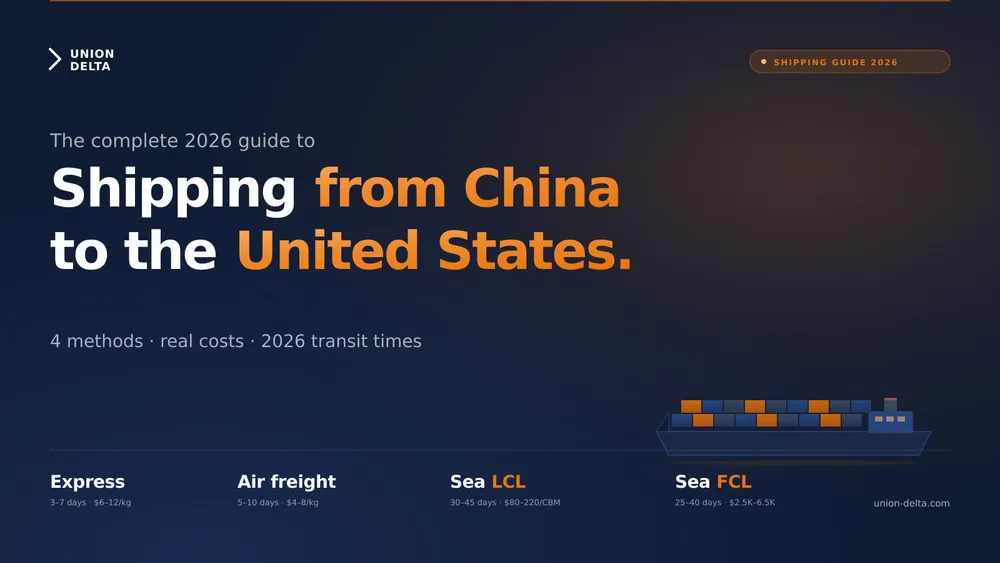
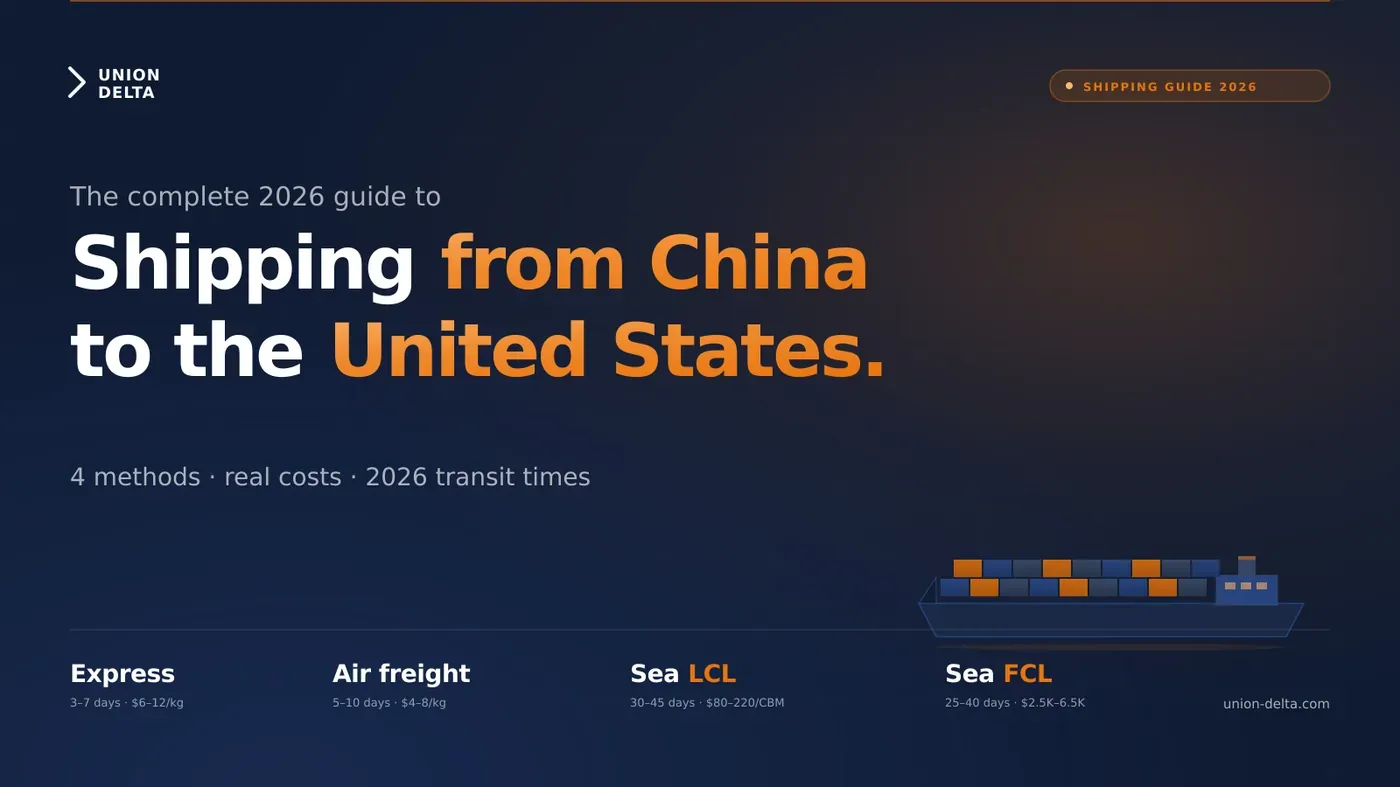
Four Ways to Ship from China to the US — Which to Use When
There are really only four shipping methods you need to know about, and the right choice depends almost entirely on one thing: the size of your shipment. Here's the short version before we get into the details.
| Method | Best for | Transit time | Cost range |
|---|---|---|---|
| Express courier (DHL, FedEx, UPS) | Samples and small shipments under 200 kg | 3–7 days | $6–$12/kg |
| Air freight | Shipments 200–500 kg, urgent restocks | 5–10 days | $4–$8/kg |
| Sea freight LCL (Less than container load) | Shipments 2–15 CBM | 30–45 days | $80–$220/CBM |
| Sea freight FCL (Full container) | Shipments over 15 CBM | 25–40 days | $2,500–$6,500/container |
Costs are 2026 market rates and fluctuate with fuel prices, season, and carrier capacity. Use these as ballpark estimates, not quotes.
Express Courier: DHL, FedEx, UPS
Express is the simplest shipping method and the one most new importers default to — sometimes because they don't know there are alternatives, sometimes because it's the right choice. About 95% of product samples and small high-value shipments go by express.
When to use express. Use express when your shipment is under about 200 kg, when you need the goods in 3–7 days, or when your product value is high enough that the shipping premium doesn't matter (small electronics, jewelry, cosmetics). Express is also the default for emergency Amazon FBA restocks — if you're stocked out and every day offline costs you $500+ in lost sales, pay for express and move on.
Which carrier is best. For shipping out of China, FedEx and UPS generally have faster customs clearance and more consistent pricing than DHL. DHL is strong for Europe-bound shipments but often slower and pricier for China-to-US. This isn't universal — different Chinese cities have different local carrier coverage, and pricing varies by supplier volume — but as a default, start with FedEx or UPS.
How to get the best price. Every express company gives discounts based on shipper volume. Your Chinese supplier gets a different rate than an express agent does, and an express agent gets a different rate than a high-volume freight forwarder. If your supplier doesn't ship FedEx often, ask them to use a local express agent — often the discount is 30–50% off the public rate. Same goes for freight forwarders: a good one will quote you better than the FedEx website.
Dimensional Weight — The Rule That Catches Everyone
Express and air freight don't always charge by actual weight. If your shipment is bulky but light (for example, foam packaging, plastic containers, or anything over-packed), you pay by dimensional weight — a volumetric calculation that the carrier uses to account for the space your cargo takes up in their plane.
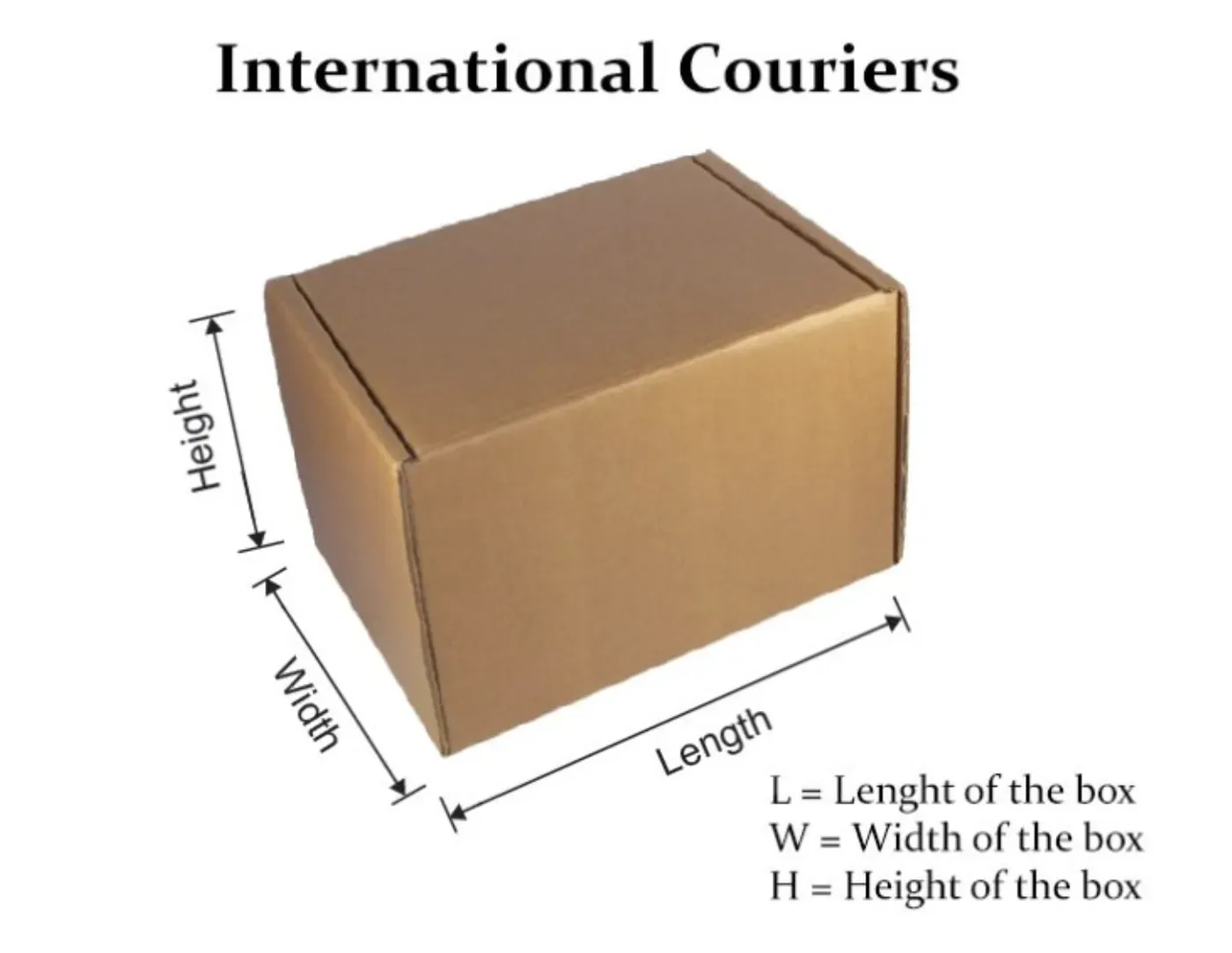
Example: a 100 × 100 × 100 cm box weighing 20 kg. Actual weight 20 kg. Dimensional weight: 1,000,000 ÷ 5,000 = 200 kg. The carrier charges you for 200 kg, not 20 kg. Ten times the price.
This is the single biggest pricing surprise for new importers. Before you book anything, calculate both the actual weight and the dimensional weight of your shipment. The carrier charges whichever is higher. If your product is bulky and light, consider compressing or flatpack packaging — it can cut shipping costs by 50%+.
Duty threshold. Shipments under $800 declared value are duty-free under the Section 321 de minimis rule (as of April 2026). Above $800, standard import duties apply in addition to any active tariffs.
Air Freight: When Express Is Too Expensive and Sea Is Too Slow
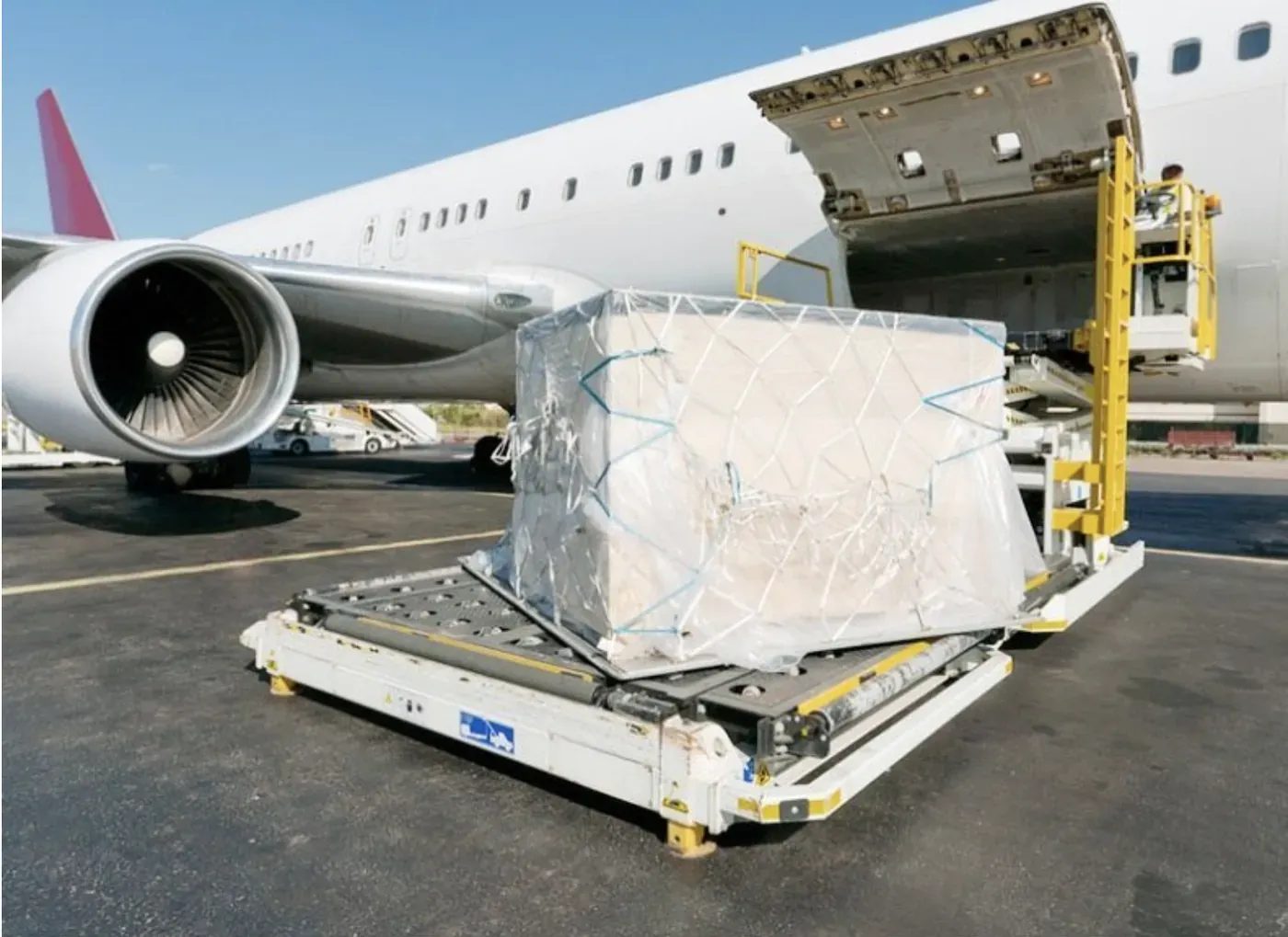
Air freight and express both use planes, but they're different services. Express is door-to-door: the carrier picks up at the factory, clears customs, and delivers to your door. Air freight is airport-to-airport (or airport-to-warehouse): you or your freight forwarder handle the pickup, export documentation, and delivery on both ends.
When to use air freight. Air freight becomes cheaper than express at around 300–500 kg. Below 300 kg, express is almost always cheaper and faster. Between 300 and 500 kg, it's a coin flip — get quotes for both. Above 500 kg, air freight wins on price every time.
Air freight has a different dimensional weight formula:
This is slightly more generous than express (÷6,000 vs ÷5,000), so bulky light shipments are relatively cheaper by air freight than by express.
The three parts of air freight cost. When you quote air freight, make sure your forwarder gives you an "all-in" price that includes these three components:
- Origin charges in China — trucking from factory to airport, export customs clearance, documentation, handling. Typically $150–$400 depending on origin city.
- Air freight — the flight itself from Chinese airport (Guangzhou, Shenzhen, Shanghai, Beijing) to a US airport (LAX, JFK, ORD, etc.). This is the biggest cost: roughly $4–$8 per kg in 2026, fluctuating with fuel and capacity.
- Destination charges in the US — import customs clearance, duties (if over $800), local trucking from airport to final destination. Typically $200–$500.
If a forwarder quotes you just "$5/kg" without breaking down origin and destination charges, ask for the full itemized quote. "All-in" can hide $600 in fees on a 300 kg shipment.
Sea Freight: The Real Workhorse for Importers Over 2 CBM
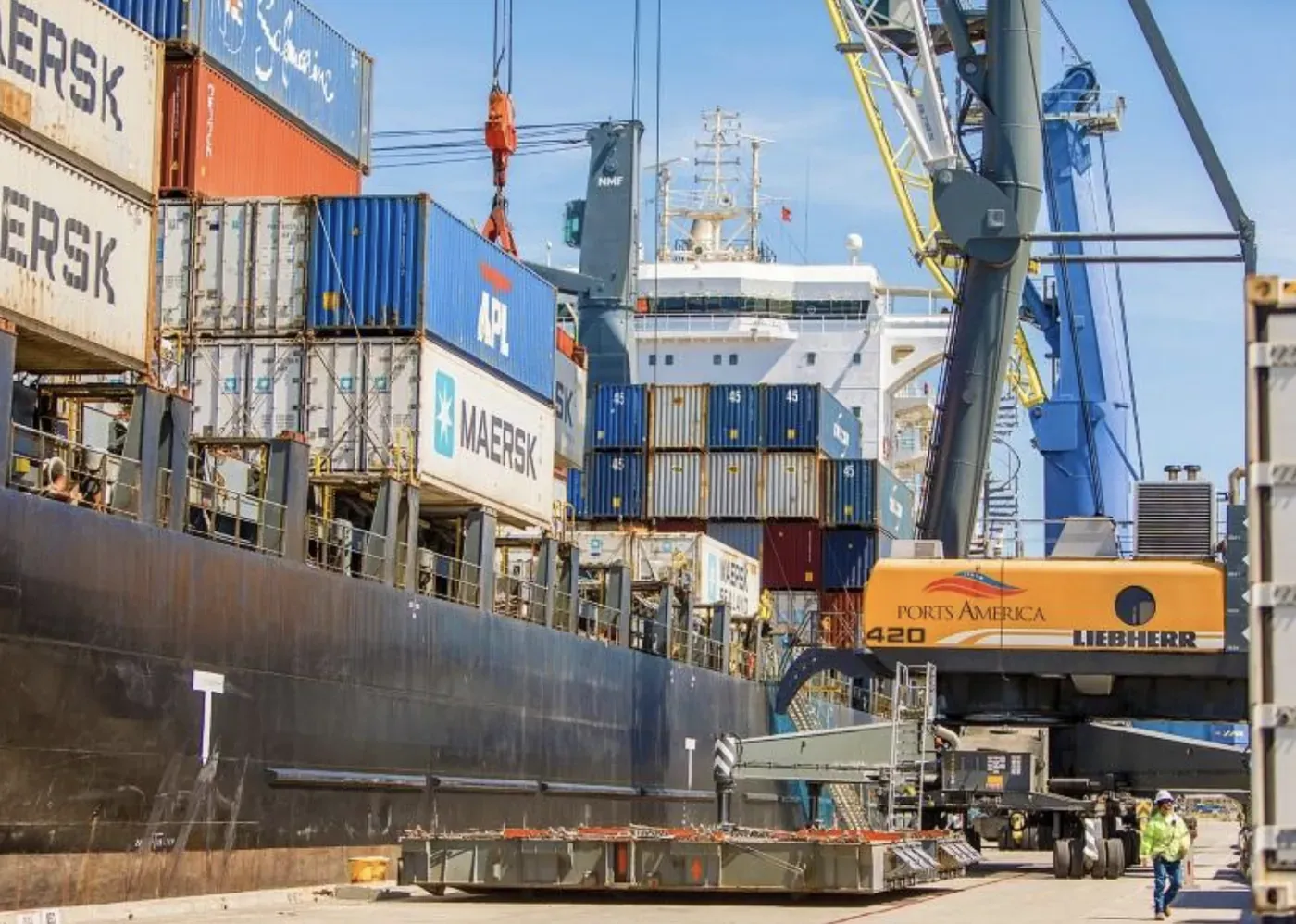
If your shipment volume is more than 2 cubic meters (CBM), sea freight is almost always the right answer. It's slower than air (30–45 days transit), but it's 5–10× cheaper per kilogram, which makes it the only viable option for most Amazon FBA sellers, wholesalers, and brand owners moving real inventory.
Sea freight splits into two categories depending on how much you're shipping: LCL (Less than Container Load) and FCL (Full Container Load).
LCL — Less than Container Load
LCL is for shipments smaller than one full container — typically 2 to 15 CBM. Your freight forwarder consolidates your cargo with other shippers heading to the same destination, and you pay by volume (per CBM).
When to use LCL. Any shipment 2–15 CBM. Below 2 CBM, air freight or express is usually cheaper once you factor in port fees and destination charges. Above 15 CBM, a full 20-foot container becomes cheaper.
Typical LCL rate in 2026: $80–$220 per CBM for China to US West Coast, $130–$280 per CBM for East Coast. Prices fluctuate with season (Chinese New Year and pre-Christmas are peak) and carrier capacity.
Watch out for destination charges. LCL quotes from Chinese forwarders often look cheap because they exclude destination fees at the US port (port handling, customs broker fees, trucking to your warehouse). These can add $400–$900 to your total. Always ask for a door-to-door quote, not port-to-port.
FCL — Full Container Load
FCL means you book an entire container for your shipment, and you pay a flat rate regardless of how full it actually is. If you fill a 20-foot container, you get the best per-unit price available. If you only fill it halfway, you still pay for the whole thing — so FCL only makes sense when your cargo actually fills most of the container.
Three container types cover 99% of US imports:
| Container | Usable volume | Max payload | Typical 2026 rate (China → US) |
|---|---|---|---|
| 20' Standard (GP) | ~28 CBM | ~28,000 kg | $2,500–$4,500 |
| 40' Standard (GP) | ~58 CBM | ~26,000 kg | $3,500–$5,800 |
| 40' High Cube (HQ) | ~68 CBM | ~26,000 kg | $3,800–$6,500 |
Rates vary by US destination port (West Coast is cheaper than East Coast) and by season. These are "all-in" door-to-warehouse estimates including port fees, customs clearance, and trucking.
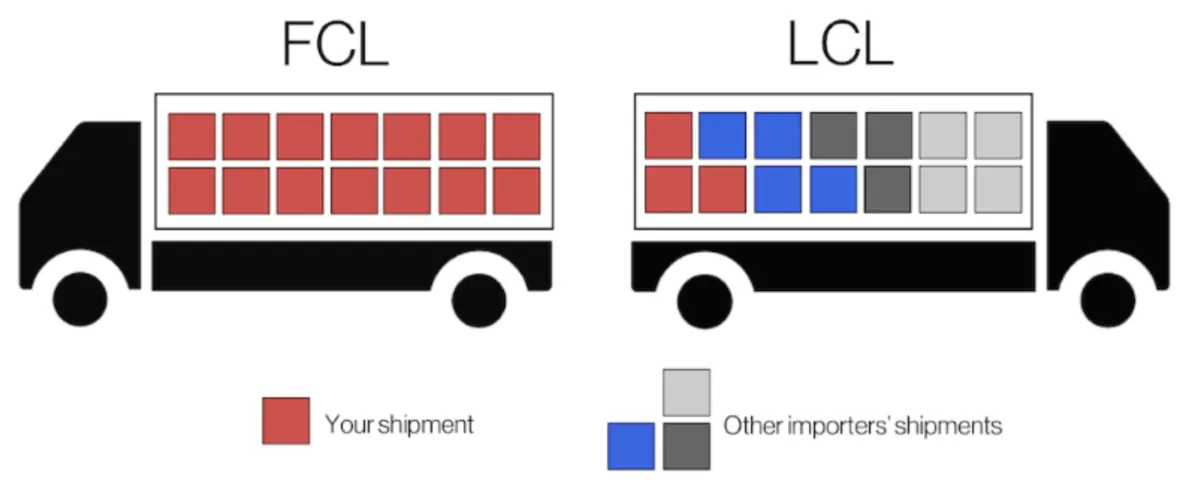
Rule of thumb: if you're shipping more than 15 CBM, run the math on a 20-foot container. Often you'll save 20–30% vs. LCL even if the container isn't completely full.
FOB vs. EXW — Know What You're Actually Buying
When your Chinese supplier quotes a price, they'll usually give it under one of two trade terms: FOB or EXW. The difference matters, because it tells you what's included in the price.
EXW (Ex Works) means the price covers only the product, sitting at the factory door. You're responsible for pickup, export documentation, trucking to the port, customs clearance, and everything after. EXW prices look cheaper on paper but usually aren't once you add all the downstream costs. Avoid EXW unless you have your own freight forwarder handling origin logistics.
FOB (Free on Board) means the supplier handles trucking to the port of shipment and export customs clearance. The price includes the product plus origin logistics in China. You pick up responsibility at the port — sea freight, destination customs, and US delivery are on you. FOB is the standard for sea freight and what you should quote whenever possible.
Most Alibaba suppliers quote EXW by default because it looks cheaper. Always ask for the FOB price too, and compare apples to apples.
SFUC and AFUC: The Hybrid Methods Most Importers Miss
Traditional sea freight has one big weakness: once your container arrives at the US port, local logistics are slow. It can take 5–10 days for your cargo to clear the port, get trucked to a distribution center, and arrive at your warehouse. For Amazon FBA sellers, this is painful — you're watching inventory sit in a port while your listings go out of stock.
There are two hybrid shipping methods designed to fix this: SFUC and AFUC.
SFUC — Sea Freight + UPS Combined
SFUC combines traditional sea freight with UPS ground for the US leg. Your cargo ships by sea to the nearest US port, then UPS takes over for customs clearance and direct delivery to your warehouse or Amazon FBA. Because UPS handles the US side with their established infrastructure, the whole shipment arrives 7–10 days faster than traditional sea freight.
SFUC is one of the most popular methods for shipping directly from China to Amazon FBA warehouses — fast enough to keep listings in stock, cheap enough to maintain margins. Typical total transit time: 25–30 days vs. 35–45 for traditional sea freight.
AFUC — Air Freight + UPS Combined
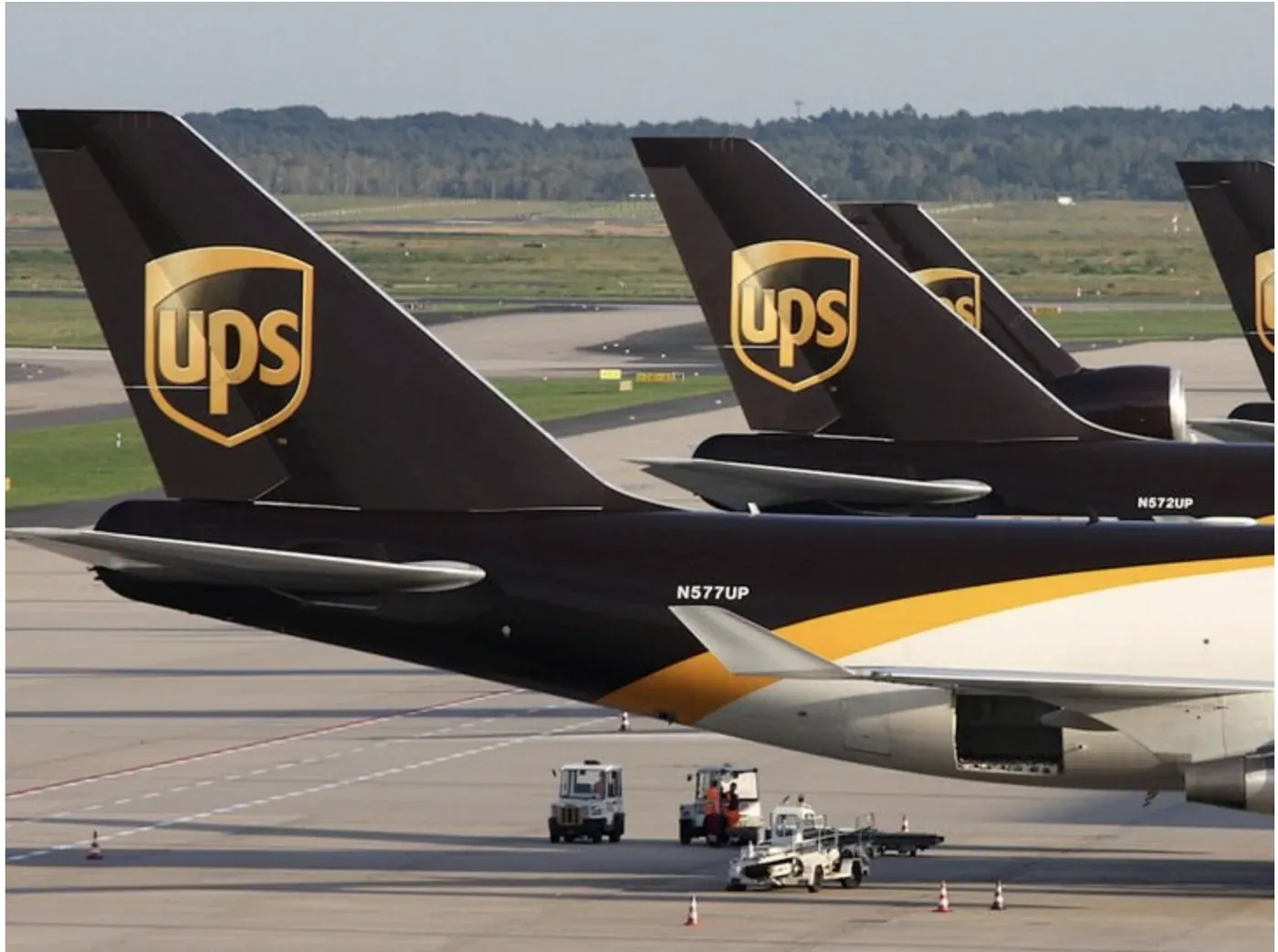
AFUC is the same concept applied to air freight. Your goods fly to a US airport, then UPS handles customs clearance and last-mile delivery. It's faster than SFUC (5–10 days total transit) and cheaper than straight express courier, making it a good middle option for shipments that need to move fast but don't justify FedEx/UPS direct express pricing.
When AFUC makes sense: 200–500 kg shipments that need to arrive within 10 days. Above 500 kg, traditional air freight is usually cheaper. Below 200 kg, straight express is simpler.
How to Calculate Total Landed Cost (Not Just Shipping)
New importers usually focus on per-unit product cost and freight cost, then get blindsided by everything else. The number that actually matters is total landed cost — what it costs to get one unit of your product into your warehouse in the US, ready to sell.
The formula:
Let's walk through a realistic example. You're importing 500 units of a consumer electronics product, with an FOB price of $8/unit out of Shenzhen, total volume 4 CBM, total weight 150 kg, declared value $4,000.
- Product cost: $4,000 (500 × $8)
- Origin fees in China: ~$180 (factory-to-port trucking, export clearance)
- Sea freight LCL (4 CBM × $150/CBM): $600
- US destination fees: ~$500 (port handling, customs broker, trucking to FBA)
- MFN duty (2.6% of $4,000): $104
- Section 301 tariff (7.5% for consumer electronics): $300
- Section 122 tariff (10%, active since Feb 2026): $400
Total landed cost: $6,084. Per-unit landed cost: $12.17, not the $8 you paid the factory. Your actual margin has to be calculated from $12.17, not from $8. This is the number that matters for pricing on Amazon.
A lot of new sellers calculate margin from product cost and get surprised by negative unit economics. The shipping is a meaningful chunk, but in 2026 the tariffs are usually bigger — and if you're building a long-term product, they're the number you need to plan around.
Common Shipping Mistakes That Cost Real Money
After shipping for clients for 12 years, we've seen the same expensive mistakes over and over. Here are the five most common ones.
1. Letting the supplier choose the shipping method. Most Chinese suppliers aren't shipping specialists. They'll default to whatever method their regular forwarder uses, which may or may not be the cheapest or fastest for your specific shipment. Always quote shipping yourself, ideally through a dedicated forwarder, and compare against what the supplier offers.
2. Choosing the cheapest quote without checking door-to-door pricing. A quote that ends at "FOB Shenzhen port" doesn't include any of the US-side costs — destination fees, customs broker, trucking to your warehouse. Those can easily add $500–$1,000 to the total. Always ask for door-to-door pricing with your warehouse address.
3. Not accounting for dimensional weight. We covered this already, but it's the single biggest surprise for new importers. Calculate dimensional weight before booking anything. If your product is bulky and light, consider flatpack or compressed packaging.
4. Underestimating transit times. "30 days sea freight" means 30 days on the water. It doesn't include factory lead time (1–4 weeks), consolidation time at Chinese port (3–7 days), US destination logistics (5–10 days), or FBA check-in (1–7 days). Total time from order to sellable stock is usually 50–70 days, not 30. Plan inventory accordingly.
5. Ignoring tariffs in cost calculations. This is the 2026 version of the old "I forgot about duty" mistake. The tariff environment is changing faster than anything else in international trade right now, and a 10% difference in tariff rate is often bigger than your entire shipping cost. Before you commit to a sourcing decision, verify current tariff rates for your HTS code — and consider whether a "China + 1" supply chain makes sense for your product category.
Which Shipping Method Should You Use? Quick Decision Guide
Here's the simple decision tree we use with clients:
- Samples or under 100 kg: Express (FedEx or UPS)
- 100–300 kg, need it fast: Express
- 100–300 kg, not urgent: LCL sea freight or AFUC
- 300–500 kg: Air freight or AFUC (get quotes for both)
- 500 kg+ by weight, under 2 CBM: Air freight
- 2–15 CBM: LCL sea freight or SFUC
- 15+ CBM: FCL (20-foot container)
- 30+ CBM: FCL (40-foot container or 40' HQ)
For Amazon FBA sellers specifically: SFUC is usually the best default for any shipment 2+ CBM. The transit time is fast enough that you don't stock out, the cost is low enough that margins are preserved, and the UPS last-mile handles FBA check-in faster than traditional sea freight.
Working with a Sourcing Partner vs. DIY Shipping
You can absolutely manage your own shipping from China. Many importers do. But once you're running more than a few shipments per year, the complexity adds up: quote requests, dimensional weight calculations, HTS classifications, customs broker coordination, tariff changes, FBA label requirements, and the inevitable phone call at 11 PM when something goes wrong at the port.
A good sourcing partner handles all of this as part of a single service. At Union Delta, shipping isn't a separate line item — it's built into how we work with US importers. We quote you a landed cost, we handle factory coordination, we book the freight, we supervise container loading, we coordinate with US customs brokers, and we make sure your goods arrive FBA-ready. One partner, one invoice, one point of contact for when things go sideways.
If you're running a product business in 2026 and spending more than a few hours a month dealing with shipping questions, that time is worth more spent on product, marketing, and growth. That's the case for a partner.
Ship from China without the headaches.
Union Delta handles sourcing, quality control, container loading, and shipping to your US warehouse or Amazon FBA. 12+ years in Guangzhou. One partner, one quote, one invoice.
Get a Free Shipping Quote