
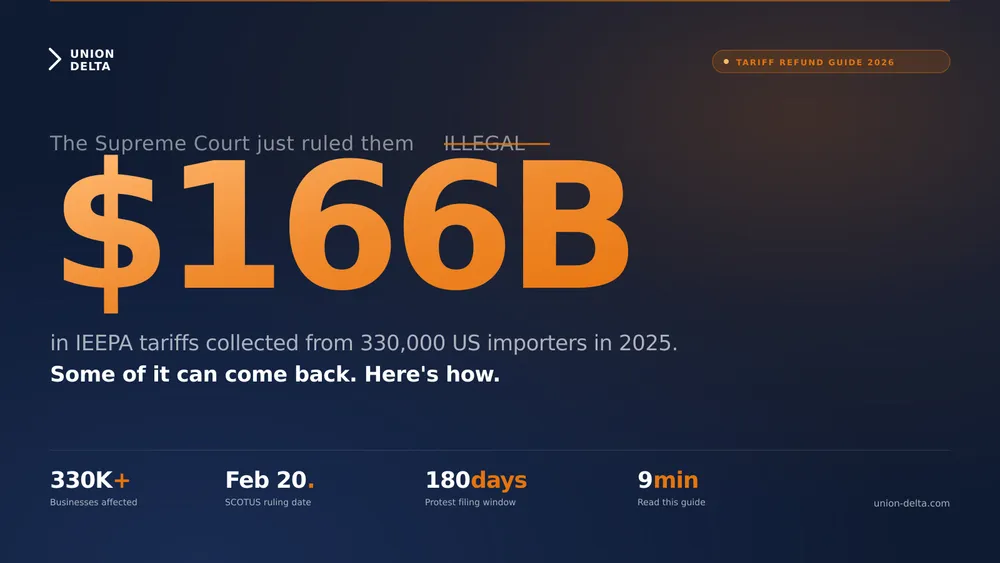
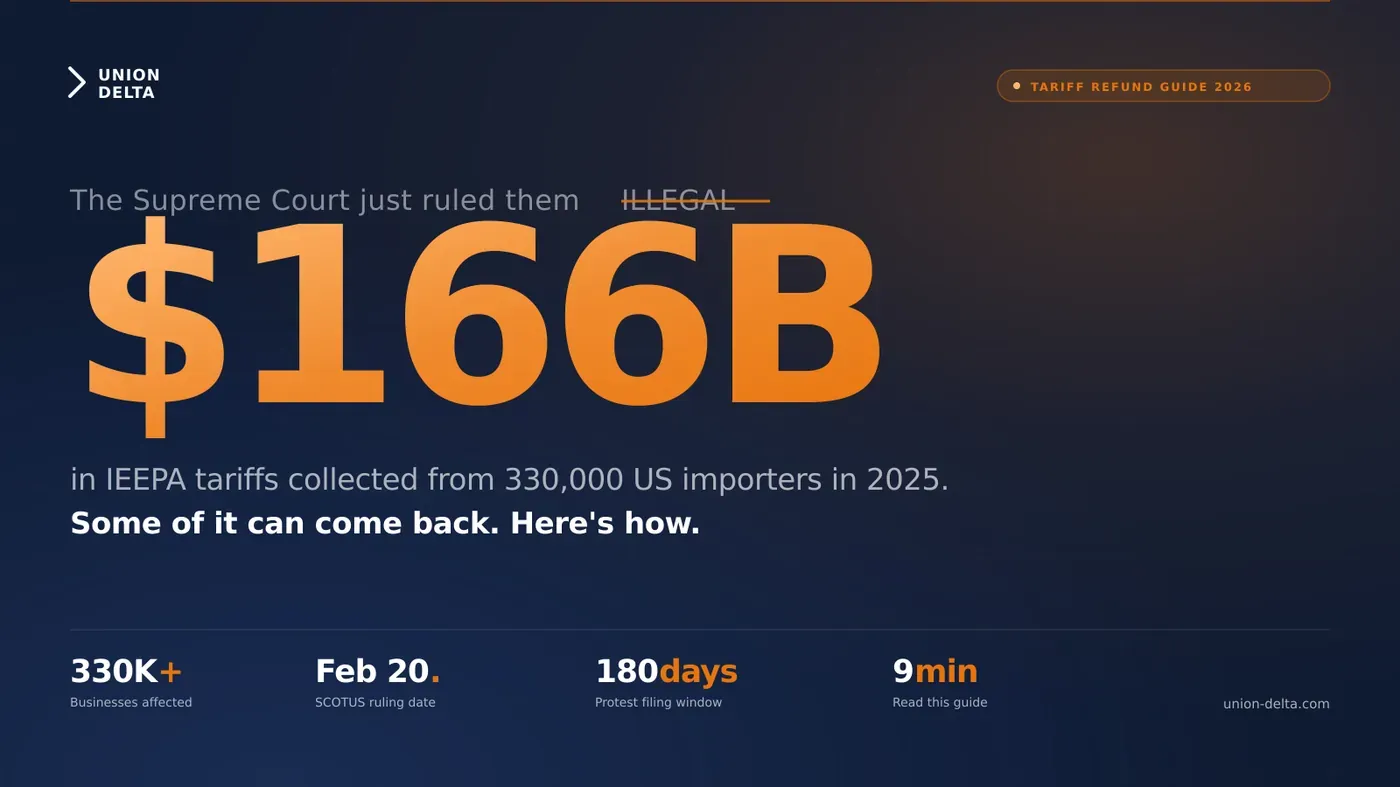
If you imported anything from China last year, you probably paid a tariff the Supreme Court just called illegal.
Here's the number that should get your attention: the federal government collected $166 billion in IEEPA tariffs from more than 330,000 US businesses in 2025. On February 20, 2026, the Supreme Court ruled those tariffs unconstitutional. The money is, in theory, refundable. But the money is not coming back automatically. You have to ask for it — with the right paperwork, filed the right way, before the deadline runs out.
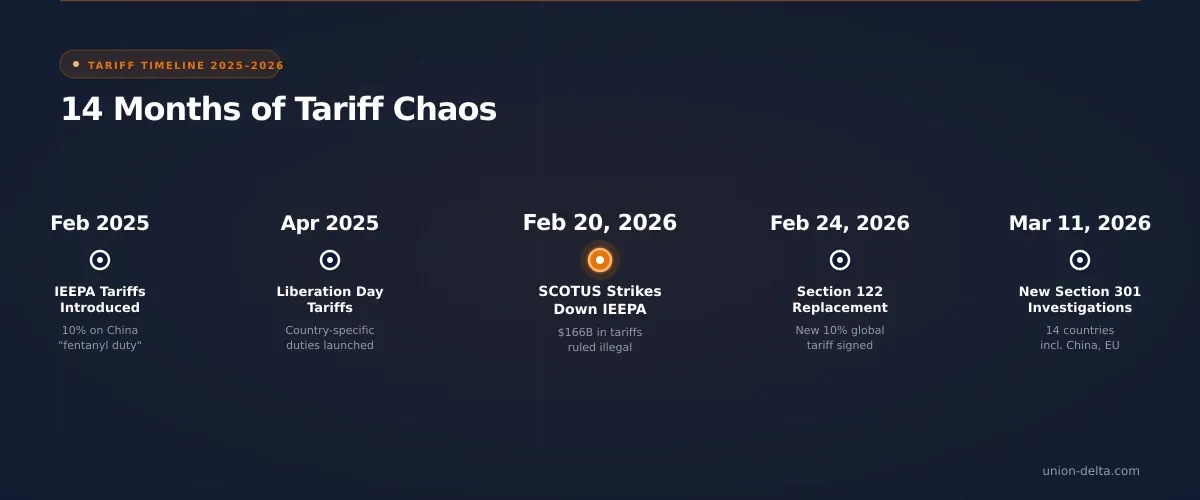
Meanwhile, the tariff landscape kept changing. Four days after the SCOTUS ruling, the White House replaced IEEPA tariffs with a new 10% global tariff under Section 122. Three weeks later, the US Trade Representative launched fresh Section 301 investigations against China, the EU, Vietnam, Mexico, India, and ten other countries. Your customs broker is probably overwhelmed. Your CFO is probably confused. And your 2025 import bills are probably still sitting in a folder, waiting for someone to do something about them.
This article walks through four things: which tariffs qualify for a refund, how to check if your business is eligible, exactly how the filing process works, and — the part most guides skip — what to do about your supply chain now that the rules have changed permanently.
What Actually Happened in February 2026
The short version: the Supreme Court ruled that the International Emergency Economic Powers Act (IEEPA) — the law the Trump administration used to justify most of the 2025 tariffs — does not give the president authority to impose import duties. Everything collected under IEEPA is, constitutionally speaking, money that shouldn't have been collected.
The tariffs affected by the ruling include the 10% "fentanyl" duty on Chinese goods introduced in February 2025 (later raised to 20%), the 25% country tariffs on Mexico and Canada, and the "Liberation Day" country-specific tariffs announced in April 2025. If you paid any of these, you're probably looking at a refund.
There's one catch called the "savings clause." Goods that were loaded onto a vessel before 12:01 AM Eastern on February 24, 2026, and cleared customs before February 28, are exempt from the ruling. Those tariffs stay collected. Everything else is on the table.
What the Court didn't do is lay out a refund process. That part is being built by Customs and Border Protection in real time, which means some importers are getting refunds in 60 days and others are waiting six months. The ones filing correctly and early are doing better than the ones waiting.
IEEPA Refunds vs. Section 301: Don't Confuse Them
This is where most importers get tripped up, and where filings get rejected. Not all the tariffs you paid in 2025 are refundable. Only IEEPA tariffs are. Here's how to tell them apart.
IEEPA tariffs are the ones that may come back. These were introduced by executive order in 2025 under the IEEPA statute. Think "fentanyl duty," Liberation Day country tariffs, the first Trump 2.0 wave.
Section 301 tariffs are the old China tariffs from 2018. Rates run from 7.5% to 100% depending on product category — electric vehicles, semiconductors, solar cells, and batteries are at the top of the range. These are not going away. They're not part of the SCOTUS ruling. If you've been paying 25% on Chinese machine tools, you're going to keep paying it.
Section 232 tariffs cover steel and aluminum (25% and 50% depending on product) under national security provisions. Also not refundable. Also not going anywhere.
Section 122 tariff is the new 10% global tariff signed into effect on February 24, 2026 — four days after the SCOTUS ruling. The administration introduced it specifically to replace the IEEPA revenue stream. It's legal, it's active, and it applies to about $1.2 trillion in imports. You're paying it right now whether you know it or not.
Here's what the stack looks like for a typical Chinese electronics shipment in 2025: base MFN duty (say 2.6%) + Section 301 (7.5%) + IEEPA fentanyl duty (20%) = 30.1% effective rate. Of that, only the 20% IEEPA portion is potentially refundable. The MFN and 301 portions stay paid.
If you don't know which tariffs you actually paid, your customs broker does. The entry summary (Form 7501) breaks it down by HTS code and tariff treatment. Ten minutes of their time will tell you whether it's worth filing anything at all.
Are You Eligible? A Quick Self-Check
Before you call anyone, run through this checklist. Six boxes to check:
- You imported goods into the US between February 2025 and February 24, 2026
- The goods came from China, Mexico, Canada, or another country affected by IEEPA executive orders
- Your entry summary shows IEEPA tariff charges (not just Section 301 or 232)
- Your goods are not covered by the savings clause (loaded after February 24 and entered after February 28)
- You have entry numbers, HTS codes, payment records, and customs broker documentation
- You were the importer of record, not the consignee
If all six are checked, you likely have a real refund claim. If any are missing or unclear, your customs broker can clarify in one phone call.
One thing worth knowing: if your 2025 import volume was small — under $50,000 — and most of it fell under Section 301 categories (electronics, machinery, chemicals), your IEEPA exposure might be minimal. Still worth checking. But don't expect a life-changing refund.
The Refund Process, Step by Step
Here's how the filing actually works. Six steps, roughly four to eight weeks of work depending on volume.
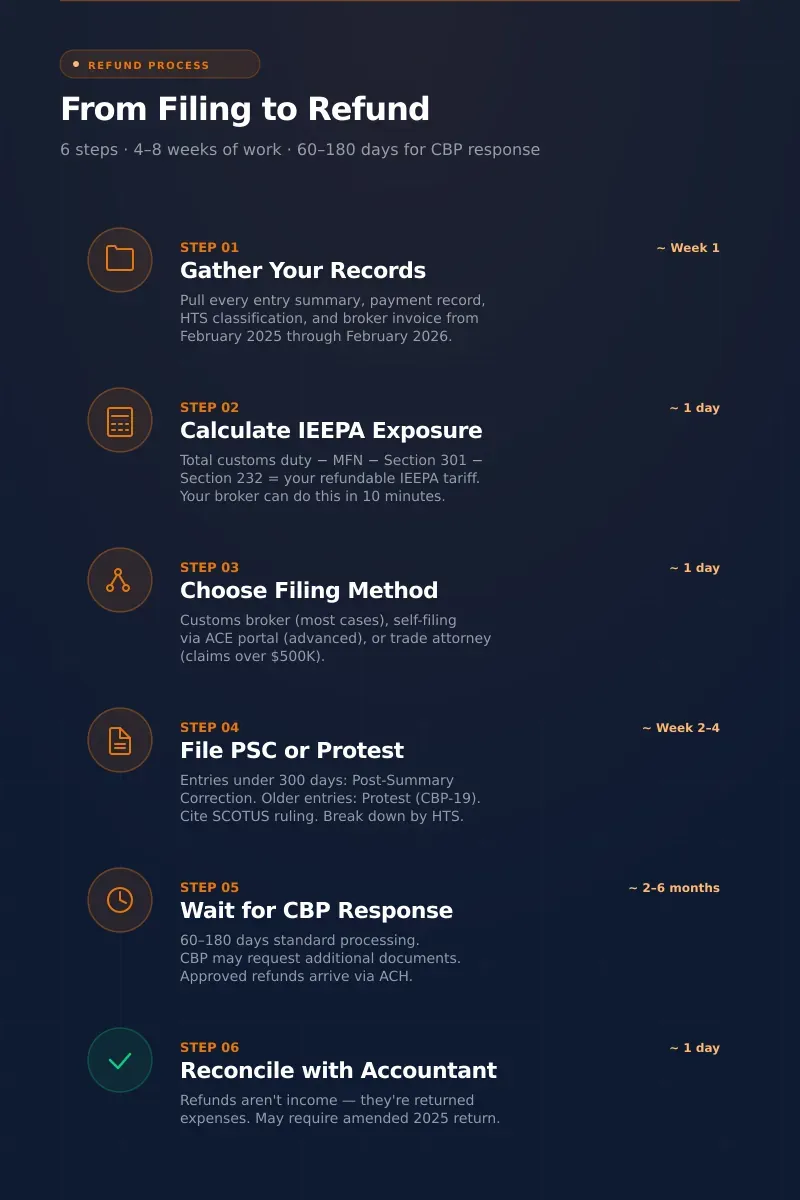
Step 1: Gather your records. Pull every entry summary from February 2025 through February 2026. You also need payment records (ACH wire transfers, customs broker invoices), HTS classifications, commercial invoices, packing lists, and bills of lading. If your broker holds all of this, ask them to compile it. If you've changed brokers, call the old one.
Step 2: Calculate your IEEPA exposure. This means separating IEEPA tariffs from everything else you paid. The formula is: total customs duty minus MFN rate minus Section 301 rate minus Section 232 rate equals IEEPA tariff paid. Here's a worked example: $100,000 electronics shipment with $2,600 MFN + $7,500 Section 301 + $20,000 IEEPA = $30,100 total paid. Potential refund: $20,000. The other $10,100 stays with the government.
Step 3: Choose your filing method. Most importers should file through their customs broker. Brokers know the CBP system, can bulk-file multiple entries, and have existing relationships that speed processing. Self-filing through the ACE portal only makes sense if you have an in-house trade compliance team and are experienced with customs filings. For claims over $500,000, add a trade attorney to the team.
Step 4: File the Post-Summary Correction or Protest. For entries younger than 300 days, use a Post-Summary Correction (PSC). For entries older than 300 days but within the protest window, file a Protest on form CBP-19. Your filing needs to cite the SCOTUS ruling, break down IEEPA charges at the HTS level, and include supporting documentation.
Step 5: Wait for CBP response. Standard processing runs 60 to 180 days, though early filers are seeing faster turnarounds. CBP may request additional documentation during review. When approved, refunds arrive via ACH to the importer of record's account.
Step 6: Reconcile with your accountant. Refunds aren't income — they're the return of previously expensed costs. If you expensed these tariffs on your 2025 taxes, you may need to amend the return. Your CPA will know what to do.
What Refunds Actually Look Like — Three Real Scenarios
Numbers make this real. Here are three profiles of what refunds look like for different sizes of import business.
Amazon FBA seller, consumer electronics. Annual import volume of $250,000 from China. IEEPA exposure in 2025: roughly $25,000 from the fentanyl duty. Potential refund: close to $25,000. For a single-operator FBA business, that's often a year's worth of working capital coming back in one check.
Mid-sized distributor, consumer goods. Annual import volume of $1.2 million, mixed sourcing from China and Mexico. IEEPA exposure: around $140,000 across both countries. Potential refund: $140,000. That's enough to absorb a year of inflation or fund an expansion into a new product line.
Hardware startup, steel components. Annual volume of $80,000, but everything fell under Section 232 steel tariffs and Section 301 machinery. IEEPA exposure: zero. Refund: zero. Still worth the ten minutes it took to check.
The lesson: refund amounts vary wildly by product category and sourcing mix. Don't assume. Don't guess. Get a customs broker to run the numbers on your specific entries.
Common Mistakes That Get Refund Claims Rejected
CBP is processing thousands of claims under a process that didn't exist two months ago. The ones getting paid are the ones filing cleanly. Here are the rejection patterns to avoid.
Filing without HTS-level breakdown. A lump-sum refund request gets rejected immediately. Every charge has to be traced to a specific entry, a specific HTS code, and a specific tariff program.
Mixing up IEEPA and Section 301. This is the most common rejection reason. Requesting a refund on charges that were never IEEPA-based just tells CBP you don't understand what you're asking for. Two rejected claims and you're in a category that gets reviewed more slowly.
Claiming savings clause goods. If your shipment loaded on February 25 and cleared on March 1, the savings clause keeps those tariffs with the government. Trying to recover them is an automatic rejection.
Missing the protest deadline. Protests have a 180-day window from liquidation date. Miss it and the claim is dead, regardless of how valid it was.
Relying on a broker who won't do the work. Some of the largest customs brokers are refusing refund filings because the workload doesn't fit their business model. If your current broker isn't moving on this, find a smaller firm that specializes in post-entry amendments.
Waiting for automatic refunds. There are no automatic refunds. CBP is not mailing checks. You have to file.
The Bigger Picture: Your Supply Chain Is Not Safe Yet
Here's the part most refund guides skip.
Getting your 2025 tariff money back is a one-time recovery event. It doesn't fix anything going forward. The effective tariff rate on Chinese imports is still 33.9% as of January 2026, according to Penn Wharton Budget Model estimates. Section 301 tariffs are still stacking on top of the new Section 122 global tariff. And the USTR just launched fresh Section 301 investigations in March 2026 against fourteen countries including China, Vietnam, and Mexico, with hearings scheduled for April and May.
Translation: the next wave of tariffs is being built right now. Any company with a single-country supply chain is one executive order away from a margin-destroying cost increase. The strategy that worked in 2019 — find the cheapest factory in Shenzhen and ride it — does not work in 2026.
What works now is a "China plus one" model: primary production in China where the supplier network is still the deepest and most capable in the world, with a backup supplier qualified in Vietnam, Mexico, India, or another lower-tariff country. When a new tariff hits, you shift volume. When inspections tighten, you have documentation ready. When lead times change, you have optionality.
This is not a quick fix. Qualifying a second supplier takes months. It involves factory audits, sample production runs, quality consistency checks, and usually a few production cycles before you can trust the operation. But it's the difference between being exposed to the next tariff shock and being able to route around it.
The importers who are going to do best over the next three years are the ones who treat their 2025 refund not as found money, but as capital to fund supply chain restructuring. Get the refund. Reinvest it in diversification. Come out of 2026 more resilient than you went in.
When You Need a Customs Broker vs. a Sourcing Partner
These are two different jobs and you probably need both.
A customs broker handles the filing. They know the CBP forms, the HTS classifications, the entry summary corrections, and the protest process. If your question is "how do I get my 2025 money back," they're your answer.
A sourcing partner (like Union Delta) handles the supply side. We find factories, run quality control inspections, manage production timelines, handle FBA prep and shipping, and build the relationships with manufacturers that make alternative sourcing possible in the first place. If your question is "how do I build a supply chain that survives the next tariff wave," that's us. See our full sourcing service page for what's included and how we charge.
Both jobs are separate. Neither of us does the other one well. The importers getting this right are running both tracks in parallel — broker working on the refund, sourcing agent working on the restructure — not sequentially.
What to Do This Week
Two things, one on each track.
On the refund side: call your customs broker and ask them to pull your 2025 entry summaries. Ask for a breakdown of IEEPA charges by HTS code. If the number is meaningful — and for most importers with Chinese supply chains it will be — ask them to prepare a PSC or protest filing. If your broker won't do the work, find one who will. Don't wait. Protest deadlines are ticking.
On the supply chain side: audit your current sourcing. Where is every component coming from? What's the effective tariff on each SKU? Where are you exposed if Section 301 rates go up again in Q3? If the answer is "everywhere," you need a diversification plan. Union Delta runs free sourcing audits for US importers building China-plus-one supply chains. We identify qualified backup factories, run cost comparisons, and handle the vetting process so you don't have to fly to Shenzhen to qualify a supplier.
The importers who come out of 2026 stronger are the ones moving on both tracks right now.

Build a supply chain that survives the next tariff wave.
Free sourcing audit for US importers. We identify qualified backup factories in China and beyond, run cost comparisons, and handle the vetting so you don't have to fly to Shenzhen.
Get a Free Sourcing Audit